
Forty freeze cycles a winter
Pitted patios and crumbling step edges are not bad luck or bad concrete. They are the predictable result of water getting somewhere it should not, roughly forty times between November and March.
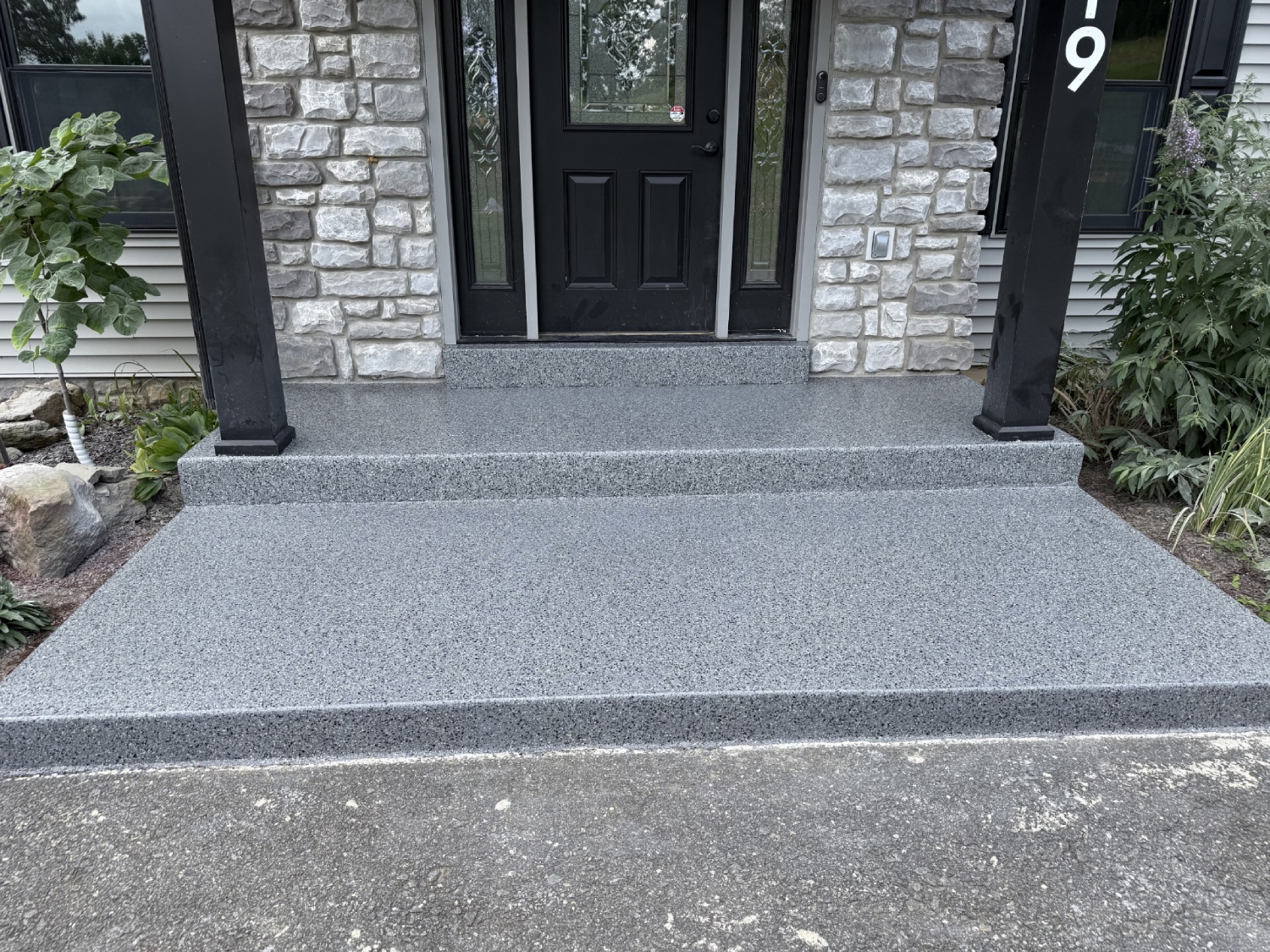
The mechanism, in one paragraph
Concrete looks solid and behaves like a sponge. The surface is full of tiny interconnected pores, and water gets into them every time it rains or snows or somebody hoses the patio down.
When that water freezes it expands by roughly nine percent. It has nowhere to go, so it pushes outward from inside the pore structure, and each freeze opens things up very slightly. In the afternoon it thaws, the water travels a little deeper into the space it just made, and overnight it does it again.
That is the whole story. Around here it happens something like forty times a winter, and it is cumulative. Five or six winters of it turns a smooth trowelled patio into a rough, dusty, pitted one, and the process accelerates as it goes because every new pit is a better water reservoir than the flat surface it replaced.
Nothing dramatic happens on any single night. That is exactly why people do not act until the damage is obvious.
Road salt is not just messy
Salt gets treated as a housekeeping problem, tracked in on the tyres, leaving white marks, easily hosed off. It is doing considerably more than that.
Salt water has a lower freezing point than plain water, so it stays liquid longer and travels further into the slab before it freezes. It gets deeper before it starts expanding, which means it does its damage further inside the concrete rather than at the surface.
It also attacks chemically. The chloride works on the cement paste holding the aggregate together, and on any steel reinforcement it reaches. That is why the concrete around a garage door opening, which gets the heaviest salt exposure of anything on the property, is nearly always the first part to break up.
Every car on the 422, the 100 and the 73 picks that up from the first gritting run and carries it home under the wheel arches. It drips off onto the same patch of garage floor all night, every night, for four months.
Where it shows first, and why
Damage is not evenly distributed, and knowing the order tells you how far along you are.
Step nosings go first. The edge of a step has concrete exposed on two faces and water sitting on a horizontal surface right at the corner, so it gets attacked from both sides at once. Once a nosing starts breaking away the repair stops being cosmetic and starts being structural.
Then the garage door threshold, for the salt reasons above. Then the tyre tracks, where salt water drips concentrate. Then the general patio surface, usually starting near a downspout or wherever water pools rather than runs off.
Basement floors and interior slabs do not go through the cycle in the same way, because they never get cold enough. Their problem is moisture from below rather than freezing from above, which is a different conversation.

Why an indoor system does not work outdoors
Coating exterior concrete is the fix, but it is not the same build as a garage floor and it is worth understanding the differences before you compare quotes.
The topcoat has to be rated for ultraviolet exposure. A standard epoxy left in direct sun ambers and chalks within a couple of seasons, which on a light coloured patio is extremely obvious. Polyaspartic topcoats specified for exterior work do not do that.
The texture has to be coarser. An outdoor slab is wet regularly and people walk on it in bare feet or wet shoes, so grip is a safety specification rather than a preference. We deliberately leave more of the chip texture standing on exterior work than we would in a living space.
And the joints have to be respected. Concrete moves with temperature, and an exterior slab moves far more than an interior one because it sees a much wider range. A coating carried straight across an expansion joint will crack in a line along that joint within the first year. The coating gets cut at the joint and terminated properly so the slab can do what it was designed to do.
What we check on an outdoor walkthrough
How far the pitting has gone, and whether repair is cosmetic or structural.
Where the water actually goes. Drainage falls have to be kept, not filled in.
Where the expansion and control joints run, and what condition they are in.
Sun exposure, which drives the topcoat specification.
How much traction the surface needs, which depends on whether it gets wet and who walks on it.
Timing, and why we move dates
Exterior work runs spring through autumn and it runs with the forecast in hand.
The slab has to be genuinely dry before anything goes down, and the system needs a settled window to cure without rain landing on it. We will move a date rather than lay a coating into weather that is about to turn. That occasionally frustrates people in the short term and it has never once produced a callback.
The practical consequence is that the calendar fills from spring onward, and the people who get the date they wanted are the ones who called over the winter. A patio booked in February for a May slot is an easy conversation. The same patio booked in June for next weekend is not.
The economics of doing it early
This is the part worth being blunt about, because it is the difference between a small job and a large one.
Sealing sound concrete is straightforward. Grind it, treat the joints, build the system, done. Almost all of the cost is the work you were always going to pay for.
Sealing damaged concrete means repairing it first. Spalled areas get cut back to something solid, pits get filled, broken nosings get rebuilt, and all of that happens before a drop of coating goes on. It is genuinely skilled work and it takes real time, and it can easily be a meaningful share of the job.
So the honest advice is unhelpful in the short term and correct in the long one. The best time to coat outdoor concrete is while it still looks like it does not need it.
What we will tell you not to do
Two things come up often enough to be worth stating.
If a slab has broken up badly, has significant movement, or has sections sitting at different heights, coating it is money spent on hiding a problem for a season. Replacement or proper concrete repair comes first, and we will say so at the walkthrough even though it means we are not doing the job that week.
And if somebody has offered to pressure wash your patio and roll a sealer on it for a small number, that is not what this is. It will look excellent for one season and it will be gone after the second winter, because nothing was ground and nothing bonded. It is the outdoor version of the failed garage kit.
What sealing actually stops
It is worth being precise about what a coating does and does not do to an outdoor slab, because the claim is often overstated by people selling it.
It stops water entering the pore structure of the concrete surface. That is the mechanism behind freeze and thaw damage, so removing the water removes the damage. It also puts a chemically resistant layer between road salt and the cement paste, which stops the second mechanism.
What it does not do is change what the slab is doing structurally. If a patio is settling, if a section has dropped, if there is movement at a joint, a coating goes along for the ride. It will crack where the concrete cracks.
It also does not make the slab stronger. A coated patio and an uncoated one have the same load capacity. What differs is how each one looks and behaves after ten more winters.
Steps deserve their own conversation
Front steps are the highest value exterior work we do and the one people put off longest, which is exactly backwards.
A step has concrete exposed on a horizontal tread and a vertical riser meeting at an unsupported edge. Water sits on the tread, runs to the nosing, and freezes right at the corner where there is the least material to resist it. That is why nosings go first on almost every set of steps in the county.
While a nosing is intact, coating it is cheap and the flake texture gives you genuinely better footing in January than smooth concrete does, which on a set of steps is not a cosmetic benefit.
Once a nosing has broken away, the repair is structural. The edge has to be rebuilt and tied in before anything can be coated over it, and rebuilt edges on steps are skilled work because they have to take load and look right.
If your steps are starting to show small breaks along the front edge, that is the moment. Next winter will make it worse and the winter after that will make it a different job.
What to look at on your own property this week
Five minutes outside will tell you where you are in the sequence.
Run a hand across the patio surface. If it feels sandy or leaves grey dust on your palm, the surface paste is already breaking down and water is getting in.
Look at the front edge of every step. Small chips and rounded corners mean the process has started.
Look at the concrete immediately inside and outside the garage door opening. That strip takes more salt than anything else on the property and it is the earliest warning you will get.
Look at where downspouts discharge, and at any spot where water sits for a day after rain rather than running off. Those are the areas that will fail first regardless of what the rest of the slab looks like.
Salt alternatives, and whether they help
Once people understand what chloride does to concrete, the next question is always whether a different de-icer would save the slab.
Somewhat, and less than you would hope. Calcium chloride and magnesium chloride are gentler on concrete than rock salt but they are still chlorides, and they still lower the freezing point which means water travels deeper before it freezes. Calcium magnesium acetate is genuinely kinder and it costs considerably more and works less well at low temperatures.
Sand is the honest answer for traction, because it does not melt anything and it does not chemically attack anything. It is also messy and it has to be swept up.
The real point is that none of this addresses what your tyres bring home from the road. You do not control what PennDOT puts on the 422, and that is the salt that ends up on your garage floor every night from November. Sealing the concrete is the only part of the chain you actually govern.
You do not control what goes on the road. Sealing the concrete is the only part of the chain you actually govern.
One more thing about shovels
A properly built exterior system takes a plastic shovel without complaint, and that surprises people who expect to have to baby it.
What we would avoid is a steel edged blade dragged hard across any finished surface, and metal wheeled equipment scraped over a step nosing. Neither will destroy the floor, both will eventually mark the topcoat in the places they land repeatedly.
Snow blowers are fine. Ice melt is fine. Hosing it clean in spring is fine and is genuinely all the maintenance an exterior coating asks for.
Catch it while the concrete is still sound
Sealing a patio that is still in one piece is a straightforward job. Repairing a spalled one and then sealing it is a different job with a different number attached. If yours is starting to go, now is cheaper than next spring.
Call (484) 942-3219 or email jfaust@cobraepoxy.com.
Book a walkthrough