
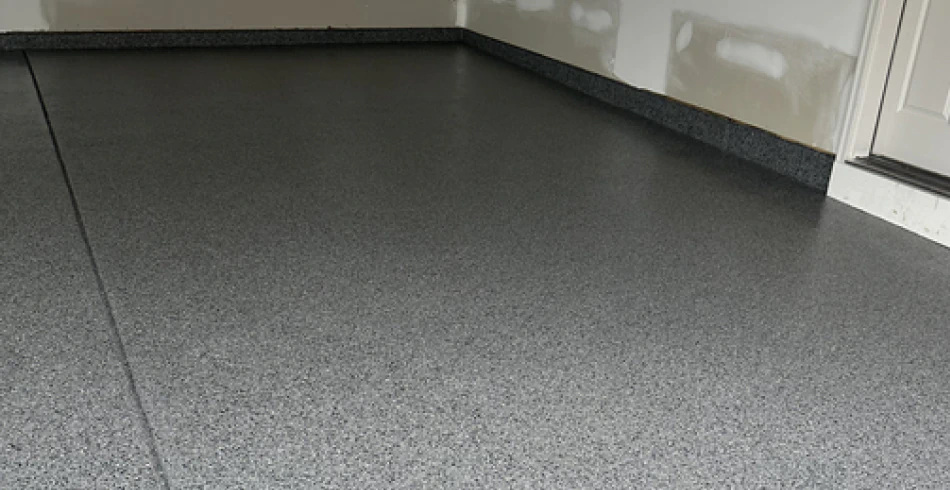
The floor your garage should have had from day one
Grind, repair, base coat, flake, polyaspartic. A garage floor built the way it should be, backed by a true lifetime warranty on residential interiors.
Residential work
What actually goes wrong with a bare slab
A garage slab takes more abuse than any other floor in the house and it is the one nobody protects. Road salt comes off the tires from November through March. Hot rubber sits on the same four patches every night. Oil, brake fluid, a dropped socket, a bike stand, a bag of concrete that got left in the corner over winter. Bare concrete absorbs every bit of it, and once a stain is in the slab it stays there.
Concrete looks solid but it drinks. The surface is porous, so salt water wicks in, freezes, expands and lifts small flakes off the top. That is the pitting you see along the tire tracks and around the door opening, and it gets worse every winter because each freeze opens the pore a little wider for the next one.
The other failure is chemical. Oil and transmission fluid soak straight in and darken permanently. Battery acid and de-icer eat at the cement paste between the aggregate. None of that is repairable once it has happened, which is why the sensible time to coat a garage is before it looks bad rather than after.
We show up, finish on time, and get it right. No hidden fees, no surprises.
Jimmy and Justyn, Cobra EpoxyWhat the price covers
Every one of these, every time
Every one of these is in the price as standard. The only thing that moves a number is what we find in the concrete, and you hear that at the walkthrough.
How we build a garage floor
The slab gets diamond ground with dust extraction until we are down to clean, open concrete. That step is not optional and it is the one that separates a floor that lasts from a floor that peels. Grinding gives the coating a mechanical profile to key into. Acid etching and pressure washing do not, which is why kits that rely on them fail so predictably.
Then every crack, divot, pit and spall gets filled and leveled. Control joints get treated properly rather than coated straight over. Only once the slab is sound does the American made base coat go down, and it goes down wet enough that the flake can be broadcast into it by hand until the surface is completely full.
The next day we scrape and vacuum the loose chip back, which is what gives the floor its even texture rather than a gritty one, and then the polyaspartic topcoat seals the whole system in. That topcoat is the layer that takes the wear, resists the chemicals and gives you the finish you actually see.
Cove base, thresholds and the edges nobody thinks about
Most of the callbacks in this trade happen at the edges. Where the floor meets the block wall, where it stops at the overhead door, where a step or a landing comes into the space. Water finds those seams first.
We run a coved base up the wall where the detail calls for it, so there is no ninety degree joint for water and dirt to sit in and no line for a mop to catch on. At the door we terminate into a saw cut rather than feathering the coating out to nothing, because a feathered edge is the first thing to chip when a tire rolls over it.
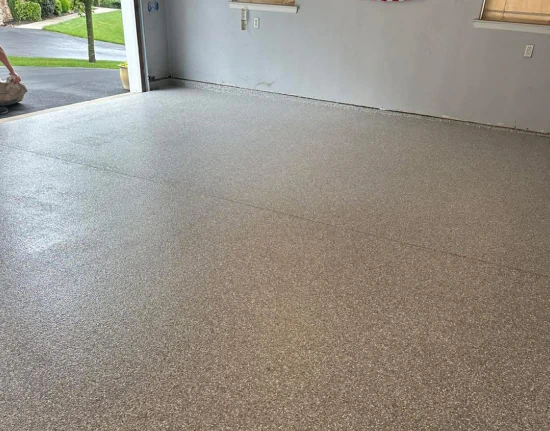
A floor that was ground properly and repaired before the first coat will still look right in ten years.
Cobra Epoxy and Flake Coatings, Boyertown PAThe four stages, every job
Stage one is the grind. Diamond grinders with dust extraction take the slab down to clean, open concrete so the coating has a mechanical profile to key into. This is the stage that decides whether a floor lasts, and it is the one kits and cheap quotes skip.
Stage two is repair. Every crack, divot, pit and spalled patch gets cut out where it needs it, filled and leveled. Control joints get treated properly rather than coated straight across. A coating laid over a crack simply prints its shape and the crack opens again anyway.
Stage three is the base coat and the broadcast. American made base goes down and bonds into the profile, and flake goes into it by hand until the wet surface will not take another handful. Full broadcast, not a scatter.
Stage four is the scrape back and the topcoat. The loose chip comes off, the floor is vacuumed, and a polyaspartic topcoat seals the system in. That topcoat is the layer that takes the wear, resists the chemicals and gives you the finish you actually look at.
When to do it, and when not to bother
The best time to coat a garage is before it looks like it needs it. A slab that is still sound only needs grinding and a handful of small repairs, so the whole job is preparation you were going to pay for anyway plus the coating. Wait until the tire tracks have pitted and the door line has spalled and a meaningful part of the bill becomes concrete repair.
Season barely matters for a garage because it is an interior floor. A closed garage holds enough temperature to cure the system through the winter, and we will bring heat to a genuinely cold slab. In practice winter is often the easier time to get booked, because our exterior work is out of season and the calendar has more room in it.
The one case where we will tell you not to do it is a slab that is structurally failing rather than surface worn. If a garage floor has heaved, dropped at a corner or cracked right through with movement either side, a coating sits on top of a problem instead of solving it. You will get told that at the walkthrough.
On the map
Where we do this work
Boyertown sits where Berks, Montgomery, Chester and Lehigh all come within reach, which is the only reason a company this size covers four counties properly. The service areas page has the full list.
At the far edge of the radius we will be straight with you about whether a small job stands up as its own trip. Asking costs nothing.
Questions
Before you book
Straight answers to the questions that come up before anybody commits to anything.
When can I park on it again?
Around three days after the topcoat goes down. You can walk on it the evening it is finished, and put boxes and shelving back the next day, but a hot tire sitting on a system that has not fully hardened is the one thing worth waiting for. Rushing that step is how people mark a brand new floor.
Will hot tires lift the coating?
Not on a professionally ground and built system. Hot tire pickup is a failure mode of thin roll on coatings that were never mechanically bonded to the slab. The tire cools, contracts, grips the film harder than the film grips the concrete, and takes it away. Grinding the slab first is what makes that impossible.
How is this different from a kit off the shelf?
A kit gives you a thin film rolled over concrete that was etched rather than ground, which is why so many of them peel within a season. We profile the slab mechanically, use professional grade American made material at a much higher build, and back the result in writing. The material cost is a small part of the difference. The preparation is most of it.
Can you coat a garage floor in winter?
Yes, interior floors go in all year. A closed garage holds enough temperature to cure the system, and we will bring heat if a slab is genuinely cold. Winter is often the easier time to book because exterior work is out of season, so the schedule is more open.
My concrete is in rough shape. Is it too far gone?
Almost certainly not. Surface damage, pitting, spalling and cracking are all normal repair work and they get sorted as part of the job. The one case where we will tell you to stop is structural movement, a slab that has heaved or dropped at a corner, because a coating sits on top of that problem rather than solving it.
Does the warranty transfer if I sell the house?
Ask us at the walkthrough and we will tell you plainly for your job rather than giving you a general answer here. What is worth knowing is that a coated garage or basement is a genuine selling point, and being able to show a buyer written paperwork from a local company that is still trading twenty minutes away carries real weight.
Do you do anything for referrals?
We do, and in an area like this it comes up more than you would expect, because garage floors are visible from the street and neighbors ask. Send somebody our way and both of you save. There are also discounts for military, police, fire and hospital workers.
I want the same floor my neighbor has. Is that possible?
Most of the time, and it happens more often than you would think. If we laid it, we know the blend. If somebody else did, bring a photo and we will get close. The caveat is light. The same chip in a north facing garage and a south facing one genuinely does not look the same.
Book a walkthrough
Get pricing on your garage epoxy floor
Send the details and Jimmy gets back to you within a business day. He walks the space, looks at the condition of the concrete, talks through the blends and puts real pricing in your hands before anything is scheduled.
Serving Boyertown and roughly fifty miles out across Berks, Montgomery, Chester and Lehigh.
Happier on the phone? (484) 942-3219. Happier writing it out? jfaust@cobraepoxy.com, or use the form on the contact page. All three land in the same place.
Tell us about the floor
Send it over and Jimmy will be in touch within a business day to arrange a look at the concrete.
More of what we coat: garage floor refinishing, flake epoxy flooring, basement epoxy flooring. See finished floors in the gallery, read about Jimmy and Justyn, or check the towns we cover. Ready to talk? Book a walkthrough.