
Thousands of chips, locked under a clear topcoat
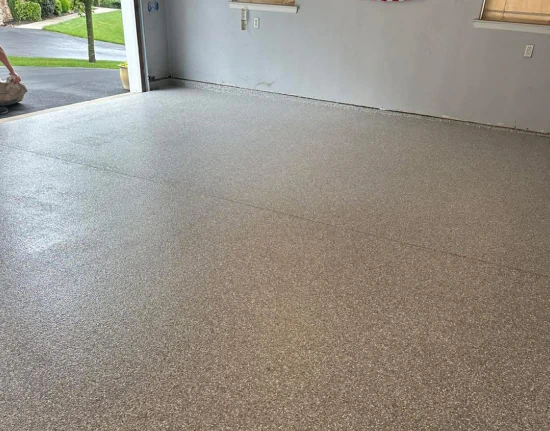
Flake broadcast is the reason these floors hide everyday marks and give you grip underfoot. Pick a blend, and we build the system around it.
Residential work
Why the broadcast is done by hand
Flake is the part of this trade people recognize before they know the name for it. Irregular vinyl chips broadcast into a wet base coat, then scraped back and sealed under a clear polyaspartic. The chips do three jobs at once. They hide the everyday marks a solid color would show, they build a texture that gives you grip when the floor is wet, and they add thickness to a system that would otherwise be a thin film of color.
The chip has to go into the base coat while it is still wet, and it has to go in until the surface will not take any more. That is called a full broadcast, and it is what separates a floor with real depth from one where the base color shows through in patches once the light hits it at an angle.
Doing that properly means throwing chip continuously across the whole slab within the working time of the base coat, which is why it is a two person job and why nobody who is rushing does it well. A partial broadcast saves material and time and it shows immediately, especially in a garage where the light comes in low through the open door.
The next day the excess gets scraped off and vacuumed up. That step is what turns a rough chip surface into an even one you can walk on barefoot. Skip it and the topcoat locks the sharp edges of the chip in place.
We show up, finish on time, and get it right. No hidden fees, no surprises.
Jimmy and Justyn, Cobra Epoxy
Choosing a blend
There are thirty one blends on the chart and they are not interchangeable. Darker blends like Raven, Tuxedo and Night Fall hide tire marks and dirt best, which makes them a common garage pick. Lighter blends like Dakota Grey, Lunar and Light Grey bounce a lot more light around, which is why they work so well in a basement with two small windows.
Warm blends such as Saddle Tan, Camel and Cappuccino tend to get chosen for patios and pool decks because they run cooler underfoot in direct sun and they sit better next to brick and stone. Coastal Blue, Sea Mist and Touch of Blue turn up around water more often than anywhere else.
Jimmy brings the samples to the walkthrough rather than asking you to pick off a screen. Chip color reads completely differently under a garage fluorescent than it does in daylight, and matching a blend to the wall color and the light in the actual room is a ten minute job in person and a guess otherwise.
What the price covers
Every one of these, every time
The build does not get trimmed to hit a number. If a slab needs more work than expected you hear about it at the walkthrough, not on the invoice.
How the floor gets built
It starts with grinding rather than cleaning. Acid etching and pressure washing leave a surface that looks prepared and is not, which is why coatings applied that way come off in sheets. We run diamond grinders with dust extraction until the concrete is open and clean.
Then the slab gets fixed. Cracks and divots filled, pitting leveled, spalled areas cut back to something sound. Whatever we find gets told to you rather than buried, because the finished floor is only ever as flat as the concrete underneath it.
The base coat goes on next, American made, and while it is still wet the flake goes in by hand across the whole area until the surface is completely full. Doing that inside the working time of the base is why it takes two people.
The following day the excess chip is scraped and vacuumed off and the polyaspartic topcoat goes over the top. That is the wear layer and the reason the floor still looks like this in ten years.
Where flake goes
Garages, basements, home gyms, laundry and mud rooms, patios, pool decks, front steps, shop floors, stockrooms, corridors and entry halls. Anywhere there is a concrete slab and a reason to want it to stop being bare concrete.
The system changes with the surface. An exterior deck gets a texture chosen for wet traction and a topcoat rated for ultraviolet exposure. An interior garage gets a smoother finish and a topcoat chosen for chemical resistance. Same idea, different specification, which is a decision that gets made on site rather than from a catalog.
A floor that was ground properly and repaired before the first coat will still look right in ten years.
Cobra Epoxy and Flake Coatings, Boyertown PAFull broadcast against partial, and why it shows
There are two ways to lay flake and the price difference between them is real. A partial broadcast throws chip lightly across the base so you get a speckled effect with the base color visible between the chips. A full broadcast keeps going until the surface will physically not take another handful, so the finished floor is chip all the way across with no base showing at all.
We build full broadcast as standard because the partial version is where the disappointment lives. It looks acceptable in a photograph taken straight down and obviously thin the moment light comes across it at an angle, which in a garage happens every time the door goes up. It is also a thinner system overall, because the chip layer contributes real build to the floor.
The scrape back matters just as much. Once the base has cured, the loose chip standing proud of the surface gets scraped off and vacuumed away before the topcoat goes on. Skip it and the polyaspartic locks thousands of sharp chip edges in place, which is how you end up with a floor nobody wants to kneel on.
On the map
Where we do this work
We run roughly fifty miles out from Boyertown, which covers Berks, Montgomery, Chester and Lehigh counties. The service areas page lists every town.
Not sure whether you are inside that? Call and ask. We would rather tell you honestly than send somebody on a two hour round trip.
Questions
Before you book
The things people ask on the phone before they book, answered the way Jimmy would answer them.
Can you help me pick a color?
That is part of the walkthrough and it is a step customers tell us other companies skip. Jimmy brings samples, holds them against your walls in your light, and talks through what each one will hide and what it will show. It takes ten minutes and it removes the only part of this process people ever regret.
Can you make it grippier in one area?
Yes, and we do it regularly. Traction is zoned rather than uniform, so an entrance that takes rain off the street or a ramp can be finished with more texture than the rest of the room. It is the same system with a different topcoat specification in that area, and it is decided on the walkthrough.
Will the color fade outdoors?
Not with the right topcoat. Exterior work gets an ultraviolet stable system, because a standard epoxy left in direct sun ambers and chalks within a couple of seasons. That is one of the specification differences between an outdoor deck and an indoor garage.
Does it need resealing every few years?
No. This is not a sealer that wears off and gets reapplied, it is a bonded system with a polyaspartic wear layer on top. Day to day it wants a dust mop and the occasional wash with a neutral cleaner. Skip the wax and anything acidic and it looks after itself.
How is this different from a kit off the shelf?
A kit gives you a thin film rolled over concrete that was etched rather than ground, which is why so many of them peel within a season. We profile the slab mechanically, use professional grade American made material at a much higher build, and back the result in writing. The material cost is a small part of the difference. The preparation is most of it.
What is not covered?
Damage rather than failure. If somebody drops an engine block on it, drags a steel skid across it, or attacks it with something acidic, that is not a system failure and we will say so. Exterior work is warranted separately because sun, ice and ground movement are conditions an interior floor never sees. It is all written down rather than left vague.
What about silica dust from the grinding?
Controlled at source, which is not optional. Dry grinding concrete without extraction throws respirable silica, and it is a genuine health exposure rather than a nuisance. Our equipment is OSHA certified and the extraction runs the whole time the grinders do. In an occupied commercial building that matters even more than it does in a garage.
Will I be dealing with the same people throughout?
Yes, start to finish. Jimmy quotes it and schedules it, Justyn runs the floor, and the crew at the walkthrough is the crew in your garage. That continuity is why nothing gets lost between the person who looked at the slab and the person who prepares it.
Book a walkthrough
Get pricing on your flake epoxy floor
Tell us roughly what you have and Jimmy will be in touch inside a business day. The walkthrough is where the real decisions get made, standing on your slab with the samples in hand rather than guessing off a screen.
We cover four counties from the shop in Boyertown, which is most of Berks plus a good piece of Montgomery, Chester and Lehigh.
Phone is quickest: (484) 942-3219. Otherwise email jfaust@cobraepoxy.com and Jimmy will pick it up. The contact page takes the same details.
Tell us about the floor
Whatever detail you have is enough to start. Expect a call within a business day.
More of what we coat: garage epoxy flooring, basement epoxy flooring, commercial flake epoxy flooring. See finished floors in the gallery, read about Jimmy and Justyn, or check the towns we cover. Ready to talk? Book a walkthrough.