
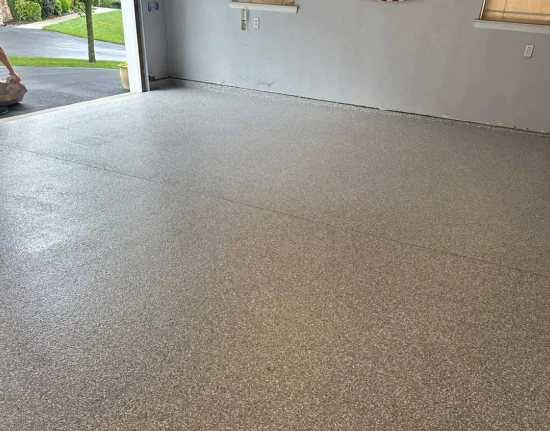
A second go at the garage floor somebody already coated once
Peeling kits, flaking roll-on epoxy, a coating another contractor walked away from: that is the work this page covers. Every scrap of the old film gets ground off first, then the floor is built properly, usually on a slab that is in good shape underneath.
The coat that came with the house
Walk through enough garages in Maidencreek Township and the same story keeps turning up. The house went up in the nineties or two thousands, somebody rolled epoxy paint or a box store kit onto the slab in the first few years, and it looked sharp for a while. Then a patch let go under a front tire, the patch crept along both tracks, and now the floor is half coating and half bare concrete with curled edges in between.
The concrete underneath is rarely what went wrong up here. Most of these garages sit on modern, flat slabs poured over a vapor barrier, which is exactly the kind of base a coating ought to hold on to. When the film fails anyway, the cause is nearly always preparation. A kit relies on an acid etch, and an etch leaves too little profile for a thin film to grip once warm tires start pulling at it every evening.
Road salt finishes what the tires started. Slush off the car sits by the door all winter, works its way under any edge that has lifted, and pries the gap a little wider every time it freezes.
Grinding the old film off is the slow part
A refinish runs longer than a fresh floor, and almost all of the extra time goes into a single step. Whatever is on the slab now has to come off, completely, with diamond grinders, because a new coating is only ever as well attached as the surface under it. Leave one patch of old film behind and the new floor starts life with a weak spot built in.
Some coatings peel away in long strips once the grinder gets under them. Others have soaked into the top of the concrete and need grinding until clean, open concrete shows wall to wall. Extraction stays on the machines the whole time, so the dust ends up in the collector and stays out of the house.
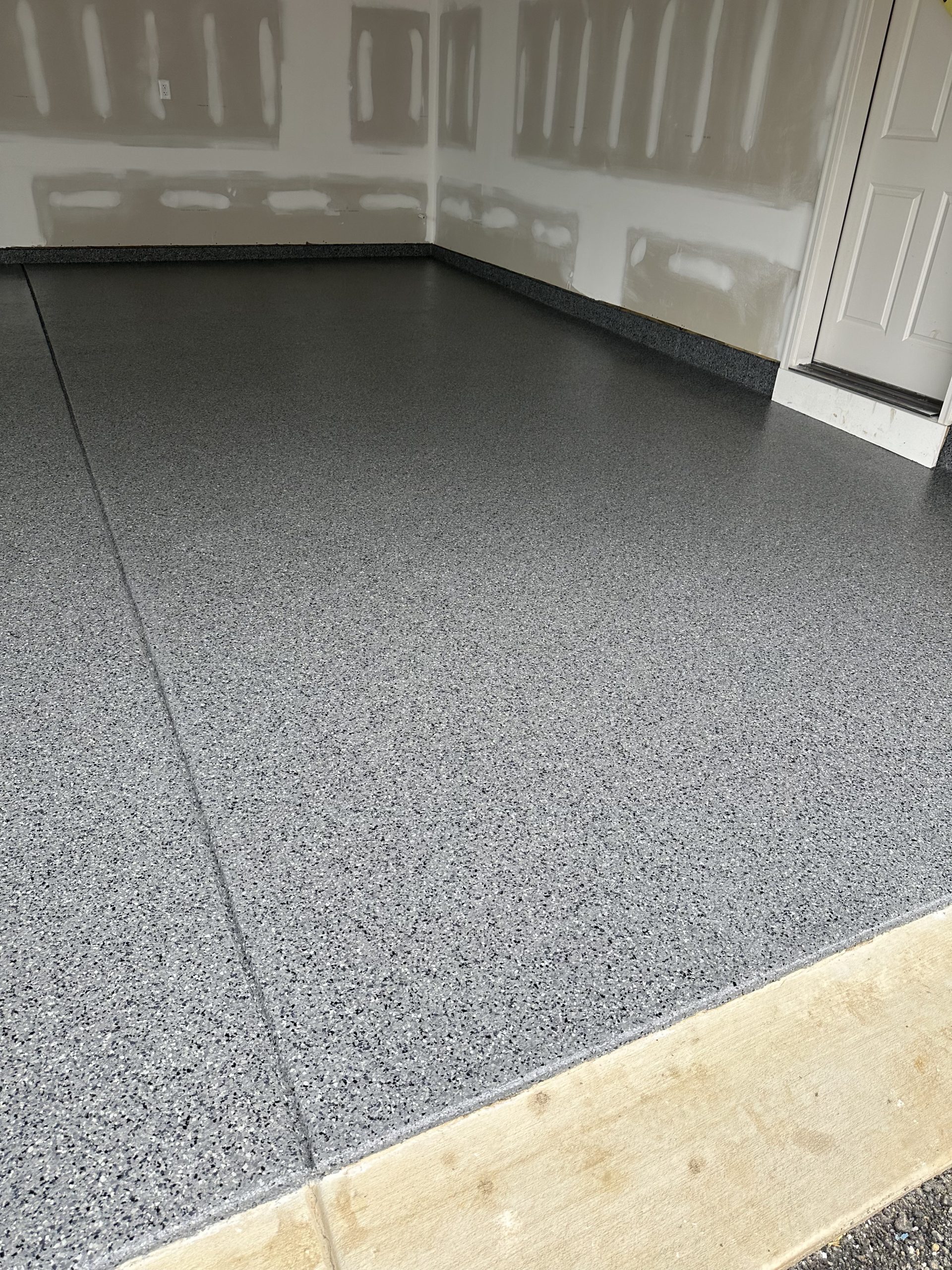
With the slab bare, the rest is a normal build: repairs, base coat, flake broadcast by hand to refusal, scrape back, polyaspartic topcoat. The garage in this photo started out new rather than stripped, and it shows the same finish a refinished floor ends up with.
PA HIC 177204, Boyertown, PARoll a new coat over a failing one and you get to watch it peel twice.
Working out why yours let go
The way a coating fails says a lot about why it failed. Jimmy reads all of this at the walkthrough, because the answer changes how the new floor gets built.
Peeling in the tire tracks
Warm tires grab a weak film and lift it a little every time the car parks. Tracks giving way while the rest holds usually points to a thin coat on an etched slab.
Lifting at the door
The strip just inside the overhead door takes the salty water first. Damage that starts there and works inward is salt getting under an edge.
Sheets away from the tracks
Big pieces letting go in the middle of the floor can mean moisture pushing up from below. Most slabs here have a vapor barrier, and we still test before assuming so.
Paint on top of paint
Some floors were recoated once already over the first failure. Every layer comes off, and the more of them there are, the longer the grind runs.
What turns up once the old coat is gone
A coating hides whatever is under it, so stripping one always tells us something new. In an older Reading garage that can mean a morning of serious repair. Under a Maidencreek floor poured in the nineties or later, the list is usually short: a hairline crack the film had been bridging, a chipped edge at the door, a divot or two where something heavy landed. All of it gets cut out where needed, filled and leveled before the base coat goes on.
Newer concrete earns some trust, and we check it anyway. A crack coated without repair simply shows its line straight back through the new finish.
One customer wrote, “I was most impressed with their prep work; every crack or divot repaired.” On a refinish, prep is most of the job, which is why a typical residential garage still runs two full days on site even when the slab underneath is sound.
That leaves the question people ask most often: could we just roll fresh paint over it? Paint bonds to the old film, and the old film is the layer that already let go. What you buy is a better looking version of the same failure, with the grinding still waiting for you next time.
Send us a few lines about the peeling and Jimmy will set up a look at the slab.Most of what we refinish was never ground in the first place.
Blandon garages, twenty miles from the shop
Blandon sits on the Route 222 corridor north east of Reading, roughly twenty miles from our Boyertown shop and comfortably inside the fifty or so miles we cover. Refinishing a garage up here is ordinary work for us, and so are calls from nearby Fleetwood and Kutztown.
On the edge of the map and not sure where you stand? Ask on the phone before you write yourself off.
Questions
Questions before we strip a garage floor
What comes up on the phone when a coating is already failing.
Can you coat over the coating that is already down?
No. Everything on the slab comes off with diamond grinders first, every patch of it. A new floor can only hold as well as whatever it is bonded to, and a peeling film is the weakest thing you could ask it to stand on. That grinding is the reason a refinish takes longer than new work.
Why did the kit on my floor peel so quickly?
A kit is a thin film rolled onto concrete that was etched with acid instead of ground. That leaves very little texture for the coating to key into, and warm tires tug at it every time you pull in. Most of them start lifting within a season, usually along the tracks first.
How long is the garage out of use?
Most residential garages are two days on site, and the floor stays closed through the evening of the second day. Plan on the cars sleeping in the driveway for that stretch. Before we start, Jimmy tells you when they can come back in, so you are never left guessing.
What if you find damage under the old coating?
It gets repaired before the base coat, and you hear about it while we are still there. On newer Blandon slabs it tends to be small, a hairline crack or a chipped edge by the door. Anything bigger than that, Jimmy shows you in person and talks it through first.
Another contractor started the job and left. Will you finish it?
Yes, and those calls are a regular part of this work. We look at what went down, how far the last crew got and what condition it is in. Then the slab is ground back to clean concrete and built from scratch, as though nobody had started it.
Can we change the color this time around?
Yes. With the old film gone the slab is bare again, so any of the thirty one blends on the chart is open to you. Jimmy brings samples to the house so you can judge them in the light of your own garage, with the door open and shut.
Book a walkthrough
Show Jimmy the floor that is peeling
Tell us roughly how big the garage is, what went down on it before and when it started to lift. Jimmy calls back within a business day, the walkthrough usually lands inside the week, and he looks at the old coating up close before any number gets put in front of you.
The product is American made, the equipment is OSHA certified, and our Pennsylvania registration is PA HIC 177204. Call (484) 942-3219, email a photo of the worst patch to jfaust@cobraepoxy.com, or fill in the contact page.
Tell us about the floor
A few lines are enough to start.
Other Blandon floors we look after
A refinished garage often sits a few steps from a back slab that could use the same attention, and the patio epoxy flooring page covers how an outdoor floor gets built differently. Homes with a pool have their own pool deck page, and if the garage threshold turns slick every January, anti slip floor coatings are worth a read. Shops and stockrooms come under warehouse epoxy flooring. The full method sits on the garage floor refinishing page, and photographs of finished floors are in the gallery. For everything else nearby, start at the Blandon page or the Berks County one.