
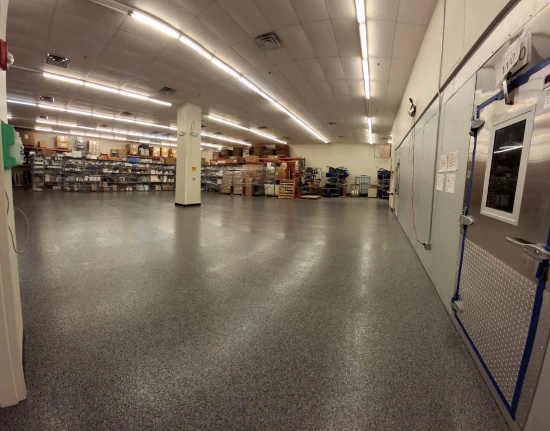
Store and shop floors that let the doors stay open
Reading is the county seat, and a good share of its floor space sits under shelving, coolers and stacked stock. We grind and coat around your business hours, with extraction on every grinder, so customers keep coming in while the floor gets done.
A pallet jack is a different load from a car
A house floor sees a car, some foot traffic and whatever falls off a workbench. A stockroom sees a pallet jack rolling the same line from the back door to the shelves, over and over, every day, on small hard wheels that press a lot of weight into a very small patch of floor. Add the turns at the end of each aisle, where the wheels scrub instead of rolling, and you have found the spots where a weak coating wears through first.
So commercial floors get specified for pallet jacks and constant traffic from the start. We do not take a garage system and spread it across a bigger room. The walkthrough is where we learn what actually rolls across your floor, where it turns, which areas get wet or mopped hard, and which parts customers look at all day.
Then the slab gets the treatment every floor we lay gets. Diamond tooling takes it down until bare, sound concrete shows, cracks and divots are repaired, and only after that does a first coat go on. A shop floor takes more punishment than any floor in a house, which leaves even less room to skip a stage.
Where shop floor coatings let go
When a commercial floor starts peeling, the cause is nearly always what happened before the first coat. A slab that was acid etched or pressure washed has no profile for the coating to key into, so the film is holding on by surface tension alone. Run a loaded pallet jack over that for a season and it comes up.
Cracks cause the other common failure. Coat straight over one and its outline prints through the finish, then it opens again. That is why repairs come before coating, and why one customer singled out our prep work, writing that every crack or divot was repaired. If your floor has a lot of cracking, the crack repair page covers what we look for.
Send us your hours and Jimmy calls within a business day.The walkthrough starts with one question: when can nobody be on this floor?
The rooms behind a storefront
Sales floor
Customers see it before they see the stock. It has to look clean under fluorescent tubes and keep looking that way down the aisles people walk most.
Stockroom
Pallet jacks, hand trucks and dropped cases. Looks barely matter back here, and wear at the doorways and the turns matters a great deal.
Entrances
The first few feet inside the door take road salt and grit off every pair of winter shoes, so that strip usually shows wear before anywhere else in the store.
Scheduling around the hours you’re open
Closing a store to redo the floor costs sales, and plenty of owners would rather live with a tired floor than lose days. One customer wrote afterward: “They worked around our busy business schedule so that we never had to close.” That is the standard we plan every commercial job to.
It starts with your hours. Tell us when the doors open and close, when deliveries arrive and which days run slowest, and the job gets built around those answers. A bigger space gets divided into sections that make sense for how the room works, so part of it stays in use while the rest is coated. We talk through what has to move, and when, before anybody picks up a tool.
Dust is the other worry indoors, and fairly so with open product on the shelves. Every grinder runs with dust extraction, which keeps fine concrete dust off the stock and out of the air your staff breathe.
Getting grinders in from a city curb
Access in Reading is harder than in a township, and commercial jobs are no exception. The van usually parks on the street. From there, grinders, extraction units and every bucket of material travel through a front door and down an aisle, or around to a rear entrance off an alley that a truck cannot get down.
None of that stops a job, since it is the normal way we work in the city. It does take time, and that time is built into how we quote. A Reading store and a Blandon store with the same square footage are not the same job, which is exactly why we want to see the building before putting a number on paper.
It changes how we plan the hours too. If loading in from the street takes a while, we need to know when the sidewalk out front is quiet and whether a rear door can stay open. Small questions, and they separate a job that wraps up on schedule from one that spills into business hours. The owner’s own rule is short: we show up, finish on time, and get it right.
Covering the county seat and its neighbors
Our shop is in Boyertown, about 18 miles out, and Reading sits comfortably inside the roughly fifty miles we travel for work. Commercial floors go down anywhere in the city, whether the building is near Penn Street or out along the Route 422 bypass.
Wyomissing, Birdsboro and Blandon are right next door, and the rest of Berks County is covered as well. If your building is on the edge and you are unsure, a phone call settles it.
Questions
What store owners ask before booking
Most of these come from managers who cannot afford a quiet week.
Do we have to close while the floor is done?
We plan so you do not have to. Tell us your opening hours, delivery days and quietest times, and the job gets built around them, with larger rooms split into sections so part of the floor stays usable. One customer wrote that we worked around their busy schedule and they never had to close.
Will grinding dust get onto our stock?
Every grinder we run is connected to dust extraction, which captures the fine concrete dust at the head before it spreads through the room. We still talk through what should be covered or moved, especially open food or soft goods near the work area, and we plan the order of sections around that.
Can the floor handle pallet jacks every day?
That is what a commercial specification is for. We ask what rolls across the floor, how heavy it gets, and where it turns, then build the system for those loads from the start. A garage coating laid over a larger room is a different floor, and we will not sell it as a commercial one.
Our building is old and the slab is rough. Can it be coated?
Almost certainly. Pitting, spalling and cracks are ordinary repair work in Reading and get handled before any coating goes down. The one case where we stop is structural movement, where part of the slab has heaved or dropped, because coating over that hides the problem without fixing it.
Who actually shows up to do the work?
The person who walked your floor and put the number together is the person holding the grinder on the day. Jimmy and Justyn run Cobra, so questions during the job go straight to someone who knows the plan, and nothing gets lost between a salesperson and a crew.
How should staff clean the new floor?
A dust mop or broom for daily sweeping, and warm water with a neutral cleaner for washing. Avoid acidic cleaners, wax and polish entirely, because they either attack the finish or sit on top and dull it. If your cleaning contractor uses something specific, show us the label at the walkthrough.
Book a walkthrough
Tell Jimmy when the floor is free
Send the rough size of the space, what it gets used for and the hours when nobody can be on it. Jimmy calls back within a business day to set up a walkthrough, look at the slab and ask about getting equipment in from the street.
Every material is made in the USA, the equipment is OSHA certified, and the grinders run with dust extraction the whole time. PA HIC 177204. Call (484) 942-3219 or send the details over.
What kind of space is it?
A few lines is plenty. Expect a call back within one business day.
More Reading pages
Plenty of shops pair a sales floor with a hard wearing flake floor in the back. Owners of older buildings usually read about concrete crack repair first, and the same owners handle garage floors and basement floors at home. The full commercial epoxy flooring page has more detail, finished jobs sit in the gallery, and everything else nearby is on the Reading and Berks County pages.