
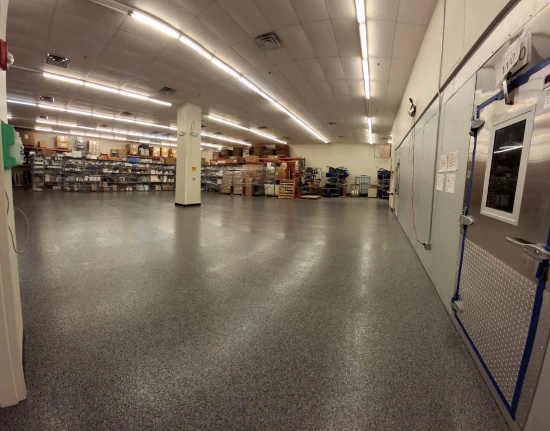
Floors that carry racking and forklifts
Specified for point loads, traffic lanes and line marking, and phased so the operation keeps running.
Commercial work
Point loads are the thing that catches people out
A warehouse floor has a completely different job to any other floor we lay. It carries concentrated point loads under racking legs, it takes steel wheels on the same lanes thousands of times a week, and it cannot be out of service. Everything about the specification follows from those three facts rather than from anything about how it looks.
A pallet rack leg puts the weight of everything above it through a plate a few inches across. That is a very different load to a car tire, and it is the load that damages new floors.
The damage almost always happens because racking was reloaded before the system had fully hardened. The floor feels solid, somebody puts a loaded beam back, and the leg plate leaves a permanent impression that no amount of cleaning removes.
So we quote return to service honestly and separately: foot traffic first, wheeled traffic next, racking and vehicles last. A contractor who gives you one number for all three has not thought about it.
We show up, finish on time, and get it right. No hidden fees, no surprises.
Jimmy and Justyn, Cobra EpoxyTraffic lanes get a different build
Wear in a warehouse is not evenly distributed. It concentrates in the lanes between racking and at the pick faces, and everywhere else barely gets touched.
That means uniform thickness across the whole floor is the wrong specification. Build goes up where the traffic is, because adding topcoat in a lane now is dramatically cheaper than rebuilding a worn lane later, and it stays standard where nothing happens.
When a lane does eventually dull, it can be abraded and recoated without disturbing the base or the broadcast underneath. Knowing that at the point you choose the system is worth more than hearing it in five years.
Your doors stay open. We work in sections, at night, over a weekend, around you.
Cobra Epoxy and Flake Coatings, Boyertown PALine marking, bays and safety zones
Walkways, bay edges, keep clear areas and hazard zones can all go in as part of the build rather than being painted on afterwards.
The difference matters. Marking applied on top of a finished floor is the first thing to wear off, because it is the highest layer and it sits exactly where the traffic goes. Marking laid into the system and sealed under the topcoat wears at the same rate as the floor around it.
It is also considerably tidier, with clean edges rather than the slightly ragged lines that come from masking a cured surface.
Working in the Lehigh Valley distribution corridor
The Route 100 and Interstate 78 corridor around Fogelsville and Trexlertown has become one of the biggest warehouse and distribution areas in the north east, and that is where a good share of this work sits.
Those buildings run long hours and many of them run continuously, which makes phasing the whole conversation. We have done floors in sections small enough that a single aisle was out of use at a time, over consecutive nights.
What makes that possible is planning rather than speed. Section sizes, routes, where stock goes, who holds access, and what happens if we find something unexpected once a section is ground. All of it goes in writing before anything starts.
What the price covers
Every one of these, every time
The build does not get trimmed to hit a number. If a slab needs more work than expected you hear about it at the walkthrough, not on the invoice.
How the floor gets built
It starts with grinding rather than cleaning. Acid etching and pressure washing leave a surface that looks prepared and is not, which is why coatings applied that way come off in sheets. We run diamond grinders with dust extraction until the concrete is open and clean.
Then the slab gets fixed. Cracks and divots filled, pitting leveled, spalled areas cut back to something sound. Whatever we find gets told to you rather than buried, because the finished floor is only ever as flat as the concrete underneath it.
The base coat goes on next, American made, and while it is still wet the flake goes in by hand across the whole area until the surface is completely full. Doing that inside the working time of the base is why it takes two people.
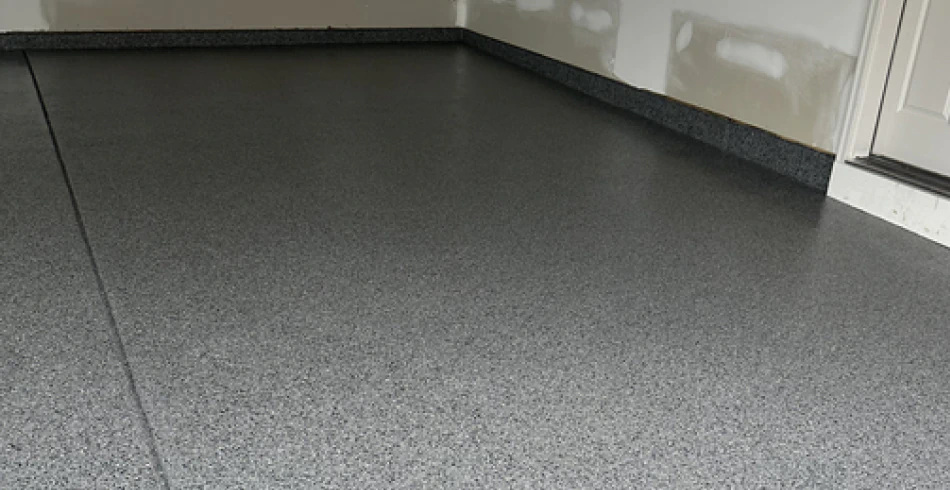
The following day the excess chip is scraped and vacuumed off and the polyaspartic topcoat goes over the top. That is the wear layer and the reason the floor still looks like this in ten years.
On the map
Where we do this work
We run roughly fifty miles out from Boyertown, which covers Berks, Montgomery, Chester and Lehigh counties. The service areas page lists every town.
Not sure whether you are inside that? Call and ask. We would rather tell you honestly than send somebody on a two hour round trip.
Questions
Before you book
The things people ask on the phone before they book, answered the way Jimmy would answer them.
How soon can we use the floor again?
Foot traffic comes back first, usually the same evening on a section. Racking, pallet jacks and vehicles wait longer while the system hardens fully. We quote those times honestly, because reloading racking too early is how a brand new floor picks up permanent indentations under the leg plates.
How far in advance should a business book?
Further than a homeowner, mostly because the scheduling conversation is longer rather than because the lead time is. Working out section sizes, access, out of hours arrangements and return to service against your actual trading pattern takes a proper walkthrough and usually a follow up. A month of notice makes for a much better job than a fortnight.
Will it handle the chemicals we use?
Tell us what they are and we will specify for them. A kennel, a commercial kitchen and a workshop all put different things on the floor, and chemical resistance is a specification decision rather than a property every coating shares. It is one of the questions we ask at the walkthrough.
Can you tell why the last one failed?
Usually, and it is worth knowing because the fix differs. Coating that peels in flexible sheets with a smooth clean underside was never ground. Blisters and patches with a dusty residue underneath are moisture. Worn through to gray in the traffic lane means there was never enough material there. Send a photograph and we can often tell you before coming out.
What is the cleaning routine?
Sweep or dust mop it, and wash it with warm water and a neutral cleaner when it needs it. In a garage a hose does the job. What you should not use is anything acidic, any wax and any polish, because those either attack the finish or sit on top of it dulling the look you paid for.
Do you charge for the visit?
No. The walkthrough is free and there is nothing attached to it. A fair share of them end with somebody deciding to do it next year, or deciding the drainage needs sorting first, and that is a perfectly good outcome. Being small and local means a visit that does not turn into work costs us twenty minutes of driving rather than something we have to recover elsewhere.
Do you work weekends?
For commercial work regularly, because that is often the only way a business stays open. For residential we mostly work weekdays, though we will do a Saturday where it genuinely solves a problem for somebody. Out of hours work costs more and we will tell you what and why rather than absorbing it quietly.
Can I see what is going on my floor?
Yes. Ask at the walkthrough and Jimmy will tell you the actual products, base and topcoat, and you are welcome to look them up. Anyone who is cagey about naming what they are putting down is worth being cautious about, because the product is not the secret. The preparation is where the work is.
Book a walkthrough
Get pricing on your warehouse epoxy floor
Tell us roughly what you have and Jimmy will be in touch inside a business day. The walkthrough is where the real decisions get made, standing on your slab with the samples in hand rather than guessing off a screen.
We cover four counties from the shop in Boyertown, which is most of Berks plus a good piece of Montgomery, Chester and Lehigh.
Prefer the phone? (484) 942-3219 reaches Jimmy directly, or email jfaust@cobraepoxy.com with a photo of the slab. The contact page has the same form with a bit more room.
Tell us about the floor
Send it across and Jimmy will be in touch inside a business day to arrange a look at the floor.
More of what we coat: commercial epoxy flooring, commercial flake epoxy flooring, anti slip floor coatings. See finished floors in the gallery, read about Jimmy and Justyn, or check the towns we cover. Ready to talk? Book a walkthrough.