
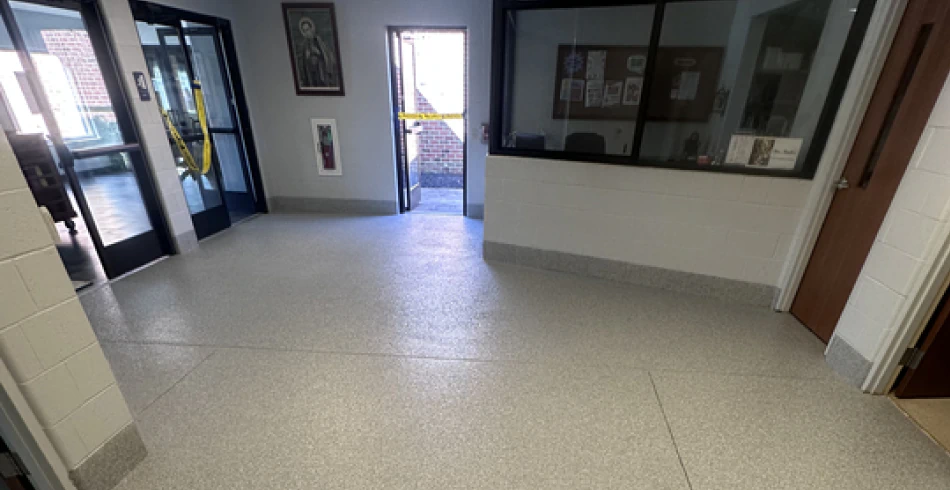
The commercial build with chip broadcast on top
Everything a business floor needs, plus a finish that hides the everyday marks a solid color puts on display.
Commercial work
Where the finish earns its keep
A solid color commercial floor looks superb for about a fortnight. Then a cart scuffs it, somebody drags a pallet, a mop leaves a streak, and every one of those marks sits on a flat field of one color where you cannot miss it. Flake solves that, which is why it has quietly become the default for any commercial space the public actually walks through.
Entry halls, corridors, showrooms, waiting areas, retail floors, school and church buildings, veterinary practices, kennels and any workshop with a customer counter in it. Anywhere the floor is seen by somebody who is forming an opinion about the business standing on it.
The chip breaks up the surface visually, so scuffs, tire marks from a hand truck and the general traffic pattern down the middle of a corridor stop reading as damage. The floor keeps looking maintained with far less effort, which for a business is the whole point.
It also gives you slip resistance in the same move. A corridor by an entrance takes rainwater in off the street every wet day of the year, and a textured floor there is a sensible decision rather than a cosmetic one.
We show up, finish on time, and get it right. No hidden fees, no surprises.
Jimmy and Justyn, Cobra EpoxySame commercial build underneath
Nothing about the structure of the system changes. The slab is still diamond ground, still repaired, still primed where the moisture reading calls for it. Build thickness is still specified for the traffic the floor will actually take rather than for a house.
The difference is the broadcast layer and a topcoat chosen to sit over the chip. On a busy commercial floor we will often go heavier on the topcoat than we would residentially, because that is the layer being worn and adding to it is far cheaper than rebuilding the system later.
Blends get chosen for the room rather than from a favorite. Darker mixes hide traffic in a workshop or a kennel. Lighter mixes lift a corridor with no natural light. Where a company has brand colors there is usually a blend that sits alongside them without trying to match them exactly, which never works.
Your doors stay open. We work in sections, at night, over a weekend, around you.
Cobra Epoxy and Flake Coatings, Boyertown PARecoating instead of replacing
A commercial flake floor is designed so the wear layer can be refreshed. When the topcoat eventually dulls in the highest traffic lane, that lane can be abraded and recoated without touching the base and the chip underneath.
That is a meaningful difference from a solid color system, where a worn patch usually means the whole area gets redone to avoid a visible edge. It is worth knowing at the point you choose the system rather than five years later.

Maintenance, and how long the finish holds
A commercial flake floor asks for very little. Regular sweeping or a dust mop, a neutral cleaner and water for a proper clean, and a scrubber if the site already runs one. No wax, no polish and nothing acidic, because those either sit on top of the finish or attack it, and neither is doing the floor any favors.
How long the surface holds depends almost entirely on the traffic lane. A corridor with trolleys going down the middle of it will dull along that line years before the edges show anything. That is normal, it is a topcoat doing its job, and it is why we specify a heavier topcoat where the traffic concentrates.
When that lane eventually needs attention, it gets abraded and recoated rather than rebuilt. The base and the chip stay exactly where they are. That is a meaningful long term difference from a solid color floor, where a worn patch usually means redoing a whole area to avoid a visible edge, and it is worth knowing when you choose the system rather than five years later.
What the price covers
Every one of these, every time
None of this is an upgrade or an optional extra. It is what the job is, and anything unusual about your slab gets raised before the work starts.
From bare slab to finished floor
Nothing goes onto a floor until the concrete is open. Diamond grinders with dust extraction take the surface skin off, along with any curing compound, old sealer, paint or soaked in oil, and leave a clean profile the coating can key into. Acid etching and pressure washing do not produce that, which is why coatings applied over them come off.
With the slab open, every defect is visible for the first time. Cracks get cut into a channel and rebuilt, pits and divots filled, spalled areas cut back to something sound and leveled flush. Whatever we find gets told to you rather than buried.
The base coat goes down into that profile, and the flake goes into the base while it is still wet, thrown by hand across the whole area until the surface is saturated. Full broadcast, not a scatter, which is what gives the floor its depth and a good part of its thickness.
The next day the loose chip is scraped off and vacuumed, and a polyaspartic topcoat goes over the top. That topcoat is the layer that takes the wear, resists the chemicals and gives you the finish you actually look at.
On the map
Where we do this work
This work goes anywhere inside our normal radius, which is about fifty miles from the shop in Boyertown and takes in four counties. Every town we have written up is on the service areas page.
If your town is not listed, that is not a no. Plenty of jobs happen in places that never got their own page, so it is worth a call either way.
Questions
Before you book
What comes up most on the first call, without the sales version.
Can you work outside our opening hours?
Yes, and for most commercial jobs that is exactly how it runs. Evenings, overnights and weekends, in sections, with a clear route through the building the whole time. It takes more planning than doing it in one go, which is why the scope goes in writing before anything starts.
How many colors are there?
Thirty one blends on the chart, from Raven and Tuxedo at the dark end through Dakota Grey and Lunar in the middle to Saddle Tan and Cookie in the warm range. Which one is right depends far more on the light in your room than on the chart, which is why the samples come to you rather than the other way round.
What can this floor not tolerate?
Very little in a normal setting, and there are limits worth naming. Strong acids will attack any resinous floor given time, and some industrial solvents soften a topcoat if they sit on it. If your process involves either, say so, because the answer is a different specification rather than a warning label.
When can we put the racking back?
Later than you will want to, and it is the one deadline worth respecting. A rack leg concentrates a lot of weight through a small plate, and a system that has not fully hardened takes a permanent impression from it. We give you a real number at the walkthrough rather than an optimistic one, because there is no repair for that short of redoing the area.
Are these floors slippery when wet?
No. The flake broadcast leaves a texture under the topcoat that gives real grip, and on pool decks, steps and entrances we specify a coarser texture deliberately. That is the reason flake is the standard choice anywhere water lands on the floor rather than a decorative preference.
Is there a deposit?
A deposit is taken to book the date and hold the material, and the balance is due on completion once you have walked the floor. The amounts are on the paperwork before you agree to anything. What we will not do is ask for the bulk of the money up front, which is the thing to be wary of generally in this trade.
Can you extend an existing coated floor into a new area?
Yes, though it is worth being realistic about the join. We can match the blend, but a new system next to one that has had a few years of wear will read slightly differently, and there will be a line where they meet. Often the better answer is to recoat the whole area so it is one floor rather than two.
How much mess does the grinding make?
Less than you would expect. The grinders run with dust extraction attached throughout, which captures the great majority of it at source. That is a health matter before it is a housekeeping one, because silica dust off concrete is a real exposure issue, and it is also why we are not filling the rest of your house with gray powder.
Book a walkthrough
Get pricing on your commercial flake floor
Tell us what you have and Jimmy will call back within a business day. He looks at the slab properly, brings the blend samples, and gives you a real number rather than a range.
Working out of Boyertown across Berks, Montgomery, Chester, Lehigh, Upper Bucks and northern Lancaster.
Jimmy picks up on (484) 942-3219 most of the day. Email works too, jfaust@cobraepoxy.com, and there is a longer form on the contact page if you would rather write it out.
Tell us about the floor
The more detail the better. Jimmy will call inside a business day to sort out a time to see it.
More of what we coat: commercial epoxy flooring, flake epoxy flooring, garage floor refinishing. See finished floors in the gallery, read about Jimmy and Justyn, or check the towns we cover. Ready to talk? Book a walkthrough.