

Where people slip, and how we build the floor so they stop
Falls happen in the same few places: the strip inside a garage door, the first few feet inside an entrance, a ramp, a run of outside steps. Around Blandon we treat slip resistance as part of the specification and choose it for the hazard in front of us, with the cleaning in mind too.
The strip inside the garage door in January
Watch where a Blandon garage gets wet in winter and it is never the whole floor. Slush falls off the tires and the boots in a band just inside the door, melts, and sits there. That band is where somebody carrying groceries steps down out of the car and learns the floor is smoother than they thought.
Bare concrete is bad enough wet. A glossy coating with nothing in it can be worse, and that is exactly the finish a lot of store kits leave behind. We put the texture where the water actually lands. Across most of a garage, a full flake broadcast already gives decent footing. At the threshold and along the tire tracks we can raise the grip further, so the floor changes where the hazard changes and stays easy to sweep everywhere else.
Most garages in Maidencreek Township sit on modern attached slabs, flat and sound, so very little of a job up here goes into repair. That frees the time for getting this part right, which is the part you notice the first icy morning.
Steps, pool edges and the people most likely to fall
At home the people who slip are rarely the ones in a hurry. It is a parent visiting for the weekend, a dog coming in off wet grass, a grandchild in socks. Exterior steps catch a lot of them, because every step is an edge with water sitting right at the corner, and the nosing is the first part of a step to wear smooth.
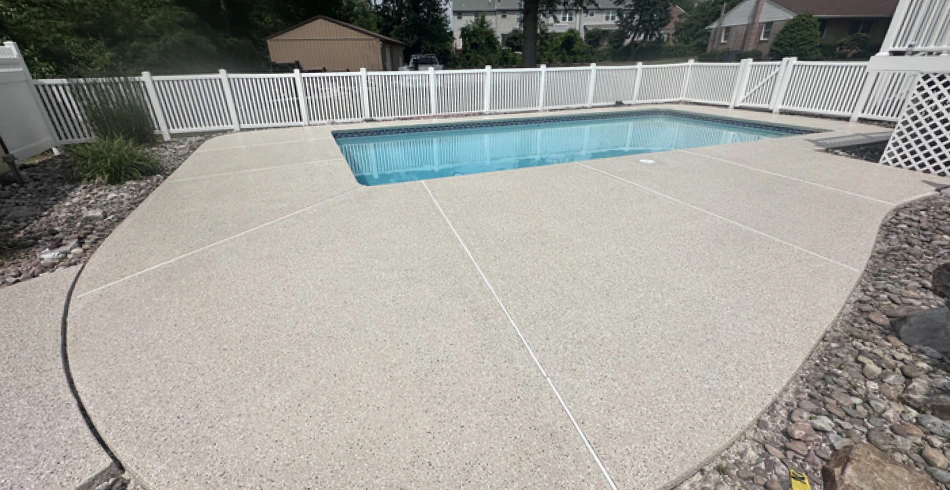
Around a pool, the risk is the band of wet concrete people cross barefoot on their way in and out. We can make that band grippier than the surface around it, which keeps the rest comfortable to lie on and easy to hose down.
Outdoors, the system also has to live with frost and sun, so it gets a UV stable topcoat and a build meant for the outside. Jimmy will tell you at the walkthrough which of your steps and edges genuinely need extra texture, and which are fine as they are.
The Cobra crewPut the grip where the water lands. Leave the rest easy to clean.
Three ways texture gets built into a floor
Each one starts from a ground slab and a sound base coat. What changes is how the relief gets into the surface, and how much of it ends up there.
Flake left standing
A full flake broadcast, scraped back less than we would indoors so more of each chip edge stays proud of the topcoat. It suits garages and home steps, and it looks like the rest of the floor.
Aggregate in the topcoat
Fine aggregate mixed into the final coat, with the grade and the amount picked for the job. It is the most controllable of the three, so it is what we reach for when a ramp or an entrance needs a known level of grip.
Quartz broadcast
Quartz sand broadcast into the build for the most aggressive needs, such as wash down areas, walk in coolers and steep ramps. It grips hard, and it is more texture than most houses will ever want.
Entrances along Route 222, and the trouble with too much grip
Small offices and shops along the Route 222 corridor share the same weak spot. Rain and snow arrive on people’s shoes, and most of it comes off in the first few feet past the door. The rest of the lobby can stay dry all day while that patch never does. We usually give the entrance a heavier texture than the floor beyond it, using aggregate so the grip is predictable, and we can phase the work so a finished section is open to foot traffic again that evening.
Overdoing it causes its own trouble. A surface that is too coarse is uncomfortable to stand on for long, it grabs dirt, and a mop drags across it without lifting much. It soon looks dirty even straight after cleaning, and people start walking around it. The aim is the least texture that does the job in that particular spot, which is why we ask how the floor gets cleaned before choosing anything.
Grinding raises silica dust, so we control it at the source with extraction on every machine. In a business that stays open while we work, that is the difference between a tidy job and a complaint at the front desk.
Tell us where people slip. Jimmy replies inside one business day.If a mop cannot clean it, the texture is too rough.
Up the road from Boyertown, near the top of our Berks range
We are up in Blandon regularly; it sits toward the northern end of our Berks County range. For a small anti slip job, say a single threshold or a short run of steps, mention it on the phone first. Jimmy will tell you honestly whether it is worth a trip on its own or makes more sense alongside other work.
Questions
What people ask once a floor has caught someone out
Usually asked after a near miss, before anyone books a walkthrough.
Can you add texture to the coating I already have?
Sometimes. If the existing coating is properly bonded, we can abrade it and put a textured topcoat over it. If it is lifting, peeling or was never stuck down well, texture on top only hides the problem, and the floor gets rebuilt from the concrete up. We check which it is before quoting anything.
Will a textured floor be hard to keep clean?
Only if it is rougher than the spot calls for. We match the texture to the hazard and to how the floor gets cleaned, so a home garage gets far less than a wash down room. On the floors we texture, a soft broom and a mop are usually all the cleaning kit you need.
How soon can people walk on it?
Foot traffic can go back onto a finished section the same evening. At a business entrance that lets us work in sections and keep a way in and out open while the rest cures. Wheels, vehicles and heavy loads wait longer, and Jimmy gives you those times plainly up front.
Is anti slip only for businesses?
No. Plenty of it is at home: garage thresholds, outside steps, a pool surround, a ramp up to a back door. Anywhere people cross a surface that gets wet, or where an older relative or a dog needs surer footing, is worth showing us when we come out.
Which of the three methods will you use?
That depends on the spot. Flake left standing suits most homes. Aggregate in the topcoat is our usual answer for entrances and ramps, because it is the most controllable of the three. Quartz is kept for wash down areas and walk in coolers, where the grip has to be aggressive.
Does the lifetime warranty cover a business entrance?
The lifetime warranty is for residential interior floors. A commercial entrance or an outdoor step sits outside it, and we would sooner tell you that now than have you find out later. Jimmy will go through what applies to your particular floor when he comes out to see it.
Book a walkthrough
Show us where people keep slipping
Tell us where it happens, what is on the floor now and roughly how much of it needs grip. Jimmy calls back within a business day, then comes out to look at the surface and at how it gets cleaned.
American made materials, an OSHA certified crew and PA HIC 177204 on every job. Call (484) 942-3219, email jfaust@cobraepoxy.com with a photo of the problem spot, or write it out on the contact page.
Tell us about the floor
A few lines are enough to start.
Elsewhere on a Blandon property
A whole backyard pool surround is covered on the pool deck epoxy flooring page, and the slab by the back door on patio epoxy flooring. A garage coating that is already peeling needs garage floor refinishing before any texture goes on, and stockrooms with cooler doors and pallet traffic are under warehouse epoxy flooring. How we specify grip in general is set out on the anti slip floor coatings page, finished floors are in the gallery, and our wider coverage sits on the Blandon and Berks County pages.