

Outdoor concrete that survives a Pennsylvania winter
Patios, front steps and walkways coated in a system chosen for freeze and thaw, ultraviolet exposure and wet footing.
Outdoor concrete
Freeze and thaw is the real enemy
An outdoor slab has a harder life than anything inside the house. It goes through roughly forty freeze and thaw cycles a winter in this part of Pennsylvania, sits under direct ultraviolet light all summer, gets rained on, salted in January and scraped with a shovel. Bare patio concrete responds to that by pitting, spalling and eventually breaking up along the joints.
Water gets into the pore structure of the concrete. It freezes overnight, expands by about nine percent, and pushes the surface apart from the inside. It thaws in the afternoon and the water goes deeper. Then it happens again the next night, and it happens dozens of times a winter here.
That cycle is what turns a smooth patio into a rough, flaking one over five or six years. Sealing the surface so the water cannot get in is the whole point of coating it, and it is why an exterior job is worth doing before the pitting starts rather than after, when the repair work becomes the bigger part of the bill.
We show up, finish on time, and get it right. No hidden fees, no surprises.
Jimmy and Justyn, Cobra EpoxyA different specification to an indoor floor
An outdoor system is not the same build as a garage. The topcoat has to be rated for ultraviolet exposure, because a standard epoxy left in direct sun ambers and chalks within a couple of seasons. The texture is coarser, because a wet patio with people walking on it barefoot needs real traction rather than a smooth gloss.
Expansion and control joints get honored rather than coated over. Concrete moves with temperature, and an exterior slab moves a lot more than an interior one. A coating carried straight across a joint will crack in a line along it within the first year. Cutting the coating at the joint and treating it properly means the slab can do what it was designed to do.
Drainage falls get respected too. A patio was poured with a slope on it so water runs off, and the coating has to follow that rather than fill it in. It sounds obvious and it is one of the things that gets missed.
A floor that was ground properly and repaired before the first coat will still look right in ten years.
Cobra Epoxy and Flake Coatings, Boyertown PAFront steps, walkways and porches
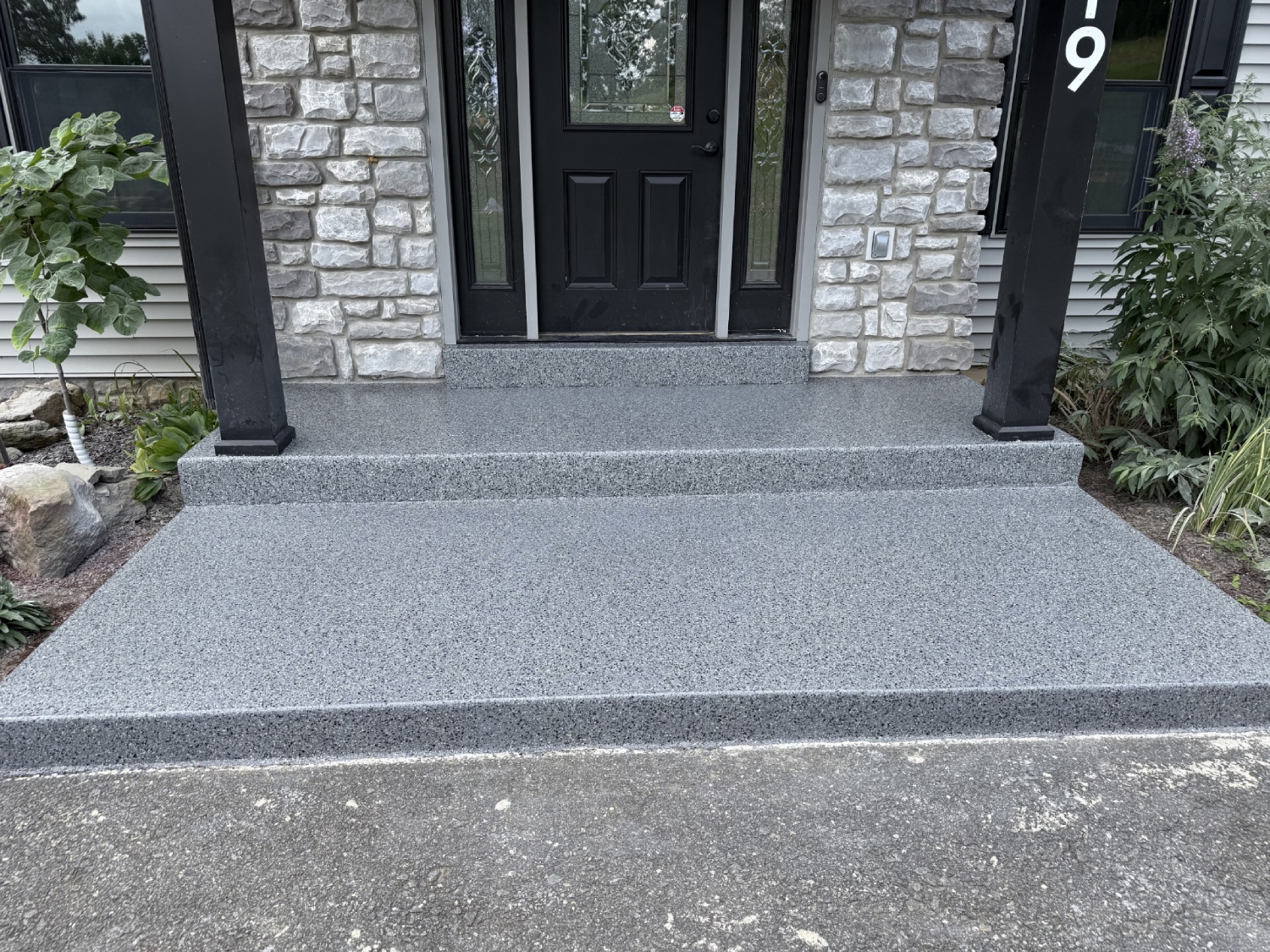
The same system goes on the parts of the property nobody thinks about until they are icy. Front steps, the walk up to the door, a side porch and the landing at the top of a set of stairs.
Steps in particular are worth doing, because a coated tread with a proper flake texture gives you far better footing in January than smooth concrete does, and because step nosings are where exterior concrete breaks down first. Water sits on the edge, freezes and takes the corner off, and once a nosing has gone the repair is structural rather than cosmetic.
Getting the timing right on outdoor work
Exterior jobs run spring through fall and they run with the forecast in hand. An outdoor slab has to be genuinely dry before anything goes down, and the system needs a settled window to cure without rain landing on it. We will move a date rather than lay a coating into bad weather, which occasionally frustrates people in the short term and has never once produced a callback.
Booking early is the practical advice. The exterior calendar fills from spring onward, and the people who get the date they wanted are usually the ones who called over the winter. A patio booked in February for May is a much easier conversation than one booked in June for next weekend.
The other timing question is condition. Outdoor concrete degrades faster than anything inside, so a patio that is smooth and sound this year may have started pitting by the time you get round to it in two years. Sealing sound concrete is inexpensive. Repairing spalled concrete and then sealing it is a different job with a different number on it.
What the price covers
Every one of these, every time
None of this is an upgrade or an optional extra. It is what the job is, and anything unusual about your slab gets raised before the work starts.
The four stages, every job
Stage one is the grind. Diamond grinders with dust extraction take the slab down to clean, open concrete so the coating has a mechanical profile to key into. This is the stage that decides whether a floor lasts, and it is the one kits and cheap quotes skip.
Stage two is repair. Every crack, divot, pit and spalled patch gets cut out where it needs it, filled and leveled. Control joints get treated properly rather than coated straight across. A coating laid over a crack simply prints its shape and the crack opens again anyway.
Stage three is the base coat and the broadcast. American made base goes down and bonds into the profile, and flake goes into it by hand until the wet surface will not take another handful. Full broadcast, not a scatter.
Stage four is the scrape back and the topcoat. The loose chip comes off, the floor is vacuumed, and a polyaspartic topcoat seals the system in. That topcoat is the layer that takes the wear, resists the chemicals and gives you the finish you actually look at.
On the map
Where we do this work
This work goes anywhere inside our normal radius, which is about fifty miles from the shop in Boyertown and takes in four counties. Every town we have written up is on the service areas page.
If your town is not listed, that is not a no. Plenty of jobs happen in places that never got their own page, so it is worth a call either way.
Questions
Before you book
What comes up most on the first call, without the sales version.
Will an outdoor coating survive the winter here?
That is what it is for. This area runs through roughly forty freeze and thaw cycles a winter, and it is water getting into the pore structure of bare concrete and expanding as it freezes that breaks a patio up. Sealing the surface stops the water getting in, which is why coating a slab before the pitting starts is much cheaper than after.
Are these floors slippery when wet?
No. The flake broadcast leaves a texture under the topcoat that gives real grip, and on pool decks, steps and entrances we specify a coarser texture deliberately. That is the reason flake is the standard choice anywhere water lands on the floor rather than a decorative preference.
Will the color fade outdoors?
Not with the right topcoat. Exterior work gets an ultraviolet stable system, because a standard epoxy left in direct sun ambers and chalks within a couple of seasons. That is one of the specification differences between an outdoor deck and an indoor garage.
What happens at the expansion joints?
They get honored rather than coated over. Concrete moves with temperature and an exterior slab moves a lot, so a coating carried straight across a joint cracks in a line along it within the first year. We cut the coating at the joint and treat it so the slab can move the way it was designed to.
How do I look after it?
A dust mop for the everyday and a mild cleaner with warm water when it needs more. No wax, no polish and nothing acidic. For a garage, hosing it out is fine. The finish does not need sealing or topping up, which is rather the point of it.
What happens if it rains on the day?
We move it. That is the whole answer, and it occasionally frustrates people in the moment. A coating that gets rained on before it has cured is a coating that has to come off and be done again, so there is no version of pushing through that ends well. We watch the forecast and give you as much notice as it gives us.
Can you work around a house move?
Yes, and an empty house is the easiest job we ever get. If you are buying, the window between completion and moving in is the perfect time to do a garage or a basement, because the slab is genuinely clear and nothing has to be shifted. Worth booking as soon as you have a date.
Can I see what is going on my floor?
Yes. Ask at the walkthrough and Jimmy will tell you the actual products, base and topcoat, and you are welcome to look them up. Anyone who is cagey about naming what they are putting down is worth being cautious about, because the product is not the secret. The preparation is where the work is.
Book a walkthrough
Get pricing on your patio epoxy floor
Send the details and Jimmy gets back to you within a business day. He walks the space, looks at the condition of the concrete, talks through the blends and puts real pricing in your hands before anything is scheduled.
Serving Boyertown and roughly fifty miles out across Berks, Montgomery, Chester and Lehigh.
Rather talk it through? Call (484) 942-3219 or email jfaust@cobraepoxy.com. You can also send the details through the contact page.
Tell us about the floor
One business day for a callback. Jimmy comes out, looks at the concrete properly and gives you a real number.
More of what we coat: pool deck epoxy flooring, flake epoxy flooring, garage epoxy flooring. See finished floors in the gallery, read about Jimmy and Justyn, or check the towns we cover. Ready to talk? Book a walkthrough.