
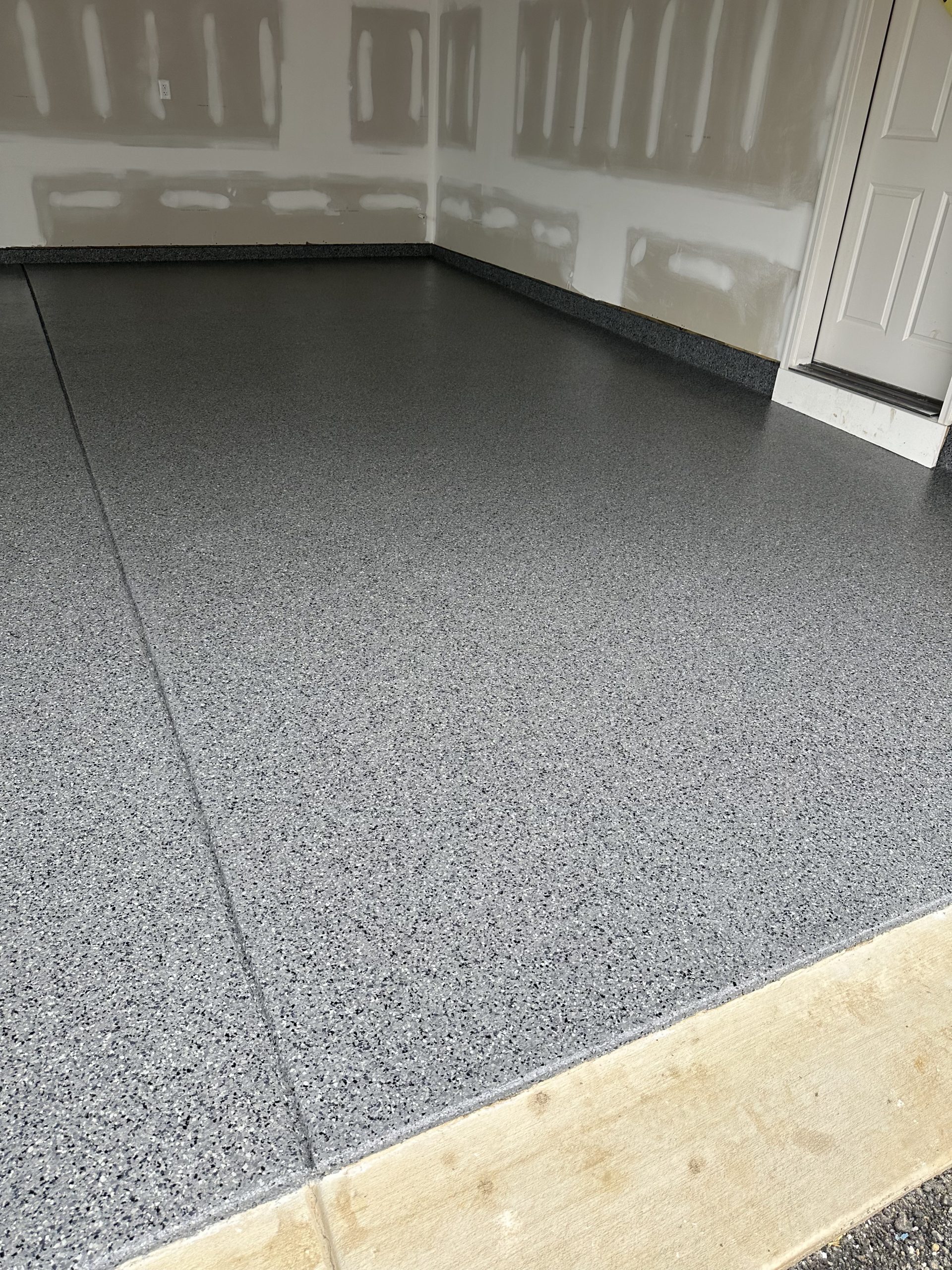
A real floor for the garage off the alley
Plenty of Reading garages sit detached behind the house, narrow and poured years apart from everything around them. Coated, that dark brick box turns into space you actually use, and the road salt stops eating the slab.
Why an alley garage is a job of its own
City garages are rarely attached to the house. A lot of them sit off an alley out back, one narrow bay wide, on a slab poured at a different time from the house, the walks and everything else on the lot. That concrete was never flat. Leveling it would be a big, pointless expense, and with flake you do not need to.
The broadcast chip breaks up the way your eye reads a surface. A dip along the wall or a hump in the middle stops showing once the topcoat is down, and the finished floor looks deliberate instead of tired.
Getting in is the awkward part. When a truck cannot fit down the alley, the grinders, the extraction and every bucket of material get walked in from a van parked out on the street. We expect that on city work and build the time in when we come to look, so nothing about the first morning catches anyone off guard.
For all that, these are some of the most rewarding floors we lay. The gap between before and after is wider in a dark garage than anywhere else on a property.

What moves back in once the floor is done
A coated garage stops being the room where things go to get dusty and forgotten. Cabinets can stand on the floor against the back wall, the snow blower can drip onto a surface that wipes clean, and the bikes and the tools can share the space with a car.
Upkeep is mostly a hose. When winter grime builds up, wash the floor with warm water and a neutral cleaner. Skip anything acidic, and never wax or polish a garage coating, since both leave the finish worse off than you found it.
There is one garage we would stop on: a slab that has moved, with a corner that has heaved or dropped. Pitting, spalling and surface cracks are ordinary repair work and get handled as part of the job, but a coating cannot hold a floor still that is shifting underneath it.
Cobra Epoxy and Flake Coatings, PA HIC 177204Flake forgives a slab that was never poured flat in the first place.
What road salt is really doing to the slab
Salt usually gets treated as a mess to hose out in spring. On a garage slab it is doing real damage, and most of that damage happens where nobody can see it.
At the door opening
The concrete just inside the door takes more salt than anything else on the property, so it is nearly always the first part of a garage floor to break up.
Below the surface
Salt water freezes at a lower temperature. It stays liquid longer and soaks further into the slab before it does, so the harm is done deep inside.
Every night, all winter
From the first gritting run, each car brings salt home off the road and drips it onto the same patch of floor overnight for about four months.
The link you control
Salt also attacks the cement paste binding the aggregate together. Sealing the slab is the one part of that chain a homeowner gets to change.
Two days on site, then the car goes back in
The first day is the long one. Diamond grinders with dust extraction take the slab down to clean, open concrete on every garage we do. A floor that was acid etched or pressure washed never had a profile for the coating to key into, and one winter of salt with a hot tire parked on top is usually enough to peel it.
With the grinding finished, every crack and divot is repaired so nothing prints through later. The base coat goes down after that, and the flake is broadcast into it while it is still wet. All of that happens on day one.
Day two is the scrape back and the topcoat. By that evening the floor takes light foot traffic. Keep the car out until around the third day, which is when vehicles can go back in. That timing covers a normal single or double bay.
Every product on the floor is made in the USA, and the equipment is OSHA certified. We are not in the quick fix business. A garage floor is supposed to outlast a lot of winters, and the only way to get there is to do the slow parts properly.
Send a photo of the garage and Jimmy gets back to you within a business day.Every car brings the road home with it. The coating keeps it out of the concrete.
Garages we reach across Reading and Berks County
The shop is in Boyertown and Reading is about 18 miles away, well within the roughly fifty mile radius we work. Alley garages near Penn Street, houses up toward the Pagoda on Mount Penn, homes out along the Route 422 bypass: all of it is normal ground for us, and so are Wyomissing, Birdsboro and Blandon.
Not sure whether your street counts? Call and ask. It takes a minute.
Questions
Garage floor questions we hear in the city
Six that come up nearly every time someone in Reading calls about a garage.
How soon can I park on the new floor?
Light foot traffic the same evening we finish, and vehicles at about the three day mark. A normal single or double bay is two days on site: grinding, repairs, base coat and flake on the first day, then the scrape back and topcoat on the second.
The alley is too narrow for a truck. Is that a problem?
No. Plenty of garages in the city are reached that way. The van parks on the street and the grinders, extraction and material are carried in by hand. It adds time to the job, and we account for that when we come out to look, so the first morning holds no surprises.
My slab is uneven. Does it need leveling first?
Usually not. Flake is very forgiving on a slab that was never flat, and the chip pattern hides the unevenness once it is sealed. The exception is a slab that has actually moved, with a corner heaved up or dropped down. A coating would only sit on top of that problem.
Is there a discount for military or first responders?
Yes. Military, police, fire and hospital workers all get a discount, and it has been part of Cobra since the beginning instead of a seasonal offer. Mention it when you call, because it gets applied by hand and will not show up on its own.
Why did the coating on my last garage floor peel?
Almost always preparation. A slab that was acid etched or pressure washed has no profile for a coating to grab, so the film is held on by surface tension alone. Road salt and hot tires find that weakness fast. Grinding down to open concrete is the step that prevents it.
Who do I call if something goes wrong later?
Jimmy. You call and we come out. The shop is in Boyertown, about 18 miles from Reading, and being that close is what gives a promise to come back any weight. A franchise office three states away cannot drive over and look at your floor.
Book a walkthrough
Get the garage out back on Jimmy’s list
Tell us whether the garage is attached or sits off the alley, how many bays it has, and what the concrete looks like right now. Jimmy gets back to you within a business day and sets a time to come out and see it for himself.
Made in the USA materials, PA HIC 177204. Call (484) 942-3219, send a photo of the slab to jfaust@cobraepoxy.com, or fill in the form on the contact page.
Tell us about the garage
A short description is plenty to start.
More Reading floors worth a look
If the house has a basement too, the basement floor page covers the moisture test those old slabs need. The chip itself is explained on the flake epoxy flooring page, broken or cracked concrete is a crack repair job first, and shops and stockrooms fall under commercial epoxy flooring. System detail is on the main garage epoxy flooring page, finished floors are in the gallery, and our wider coverage is on the Reading and Berks County pages.