
Stripping a peeling garage kit off a Blandon slab
A two thousands garage, a roll-on coating from the hardware store or the builder, and two bare stripes where the tires park. Here is how that job goes from the phone call to the cars coming back.
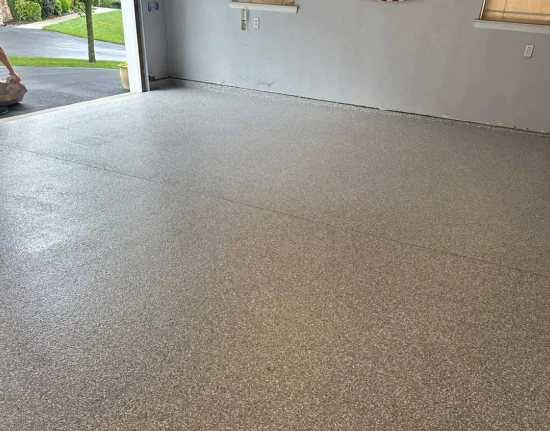
The calls start the same way nearly every time. The owner bought a house in one of the Maidencreek Township developments, the garage floor had a gray or tan coat on it when they moved in, or they rolled one on themselves the first summer, and now it is coming up. Not everywhere. In two stripes, right where the tires sit, with flakes of it stuck to the driveway and the rest of the floor looking more or less fine. They want to know whether it can be patched. The honest answer is no, and the reason is worth understanding before anyone touches it.
Two stripes where the tires park
The pattern tells you a lot before anyone kneels down. A coating that fails in the tire tracks and holds everywhere else is a coating that was never bonded well, and the tires found it first because that is where the stress is.
A car pulls in off Route 222 in July with tires that are properly hot. A thin film softens under that heat and sticks to the rubber, and when the car backs out the next morning it takes a little of the film with it. In winter the same tracks get the salt water dripping off the wheel arches, which creeps under any edge that has already lifted.
So the tracks peel first. The walls and corners hang on longer because nothing is pulling at them. They are still not bonded, they just have not been tested yet.
Working out why it let go
Jimmy’s first job at the walkthrough is to find out which kind of failure this is, because that decides what the new floor needs. The usual cause by a long way is preparation. A kit is a thin film over concrete that was washed with acid, or etched, instead of ground, and etching does not open the surface enough for anything to grip. Floors done that way often start to peel within a season.
The second cause is moisture coming up through a slab with no vapor barrier. That is far less common in Blandon than in Reading, because most of the development garages up here were poured with one, but it still gets checked rather than assumed.
The lifted pieces help. If they come away clean, with no concrete stuck to the underside, the film was only ever resting on the surface. Either way the fix starts in the same place, but knowing the cause tells us what to watch for once the slab is bare.
A coating that lets go in the tire tracks was never holding on anywhere. The tracks are just where it got found out.
Grinding off the old film is the slow part
Everything comes off. The peeling stripes, obviously, but also the parts that still look fine, because a new system laid over an old film can only ever be as well bonded as the film beneath it. Leave a patch of the old stuff in a corner and you have built your new floor on the same mistake.
That is why a refinish takes longer than a first coat on bare concrete. The diamond grinders, with extraction attached so the dust ends up in the vacuum, have to chew through the old coating before they can do their real job of opening up the concrete underneath. Some films come off quickly. Thicker builder’s coats and anything with flake already in it take patience.
The Blandon garage floor refinishing page lays out the whole process, and the main refinishing page covers the kits and failed coatings we get called about across all four counties.
What usually turns up under the film
Stripping a floor shows you concrete nobody has seen since the coating went down, and it often turns up damage the owner did not know about. On an older Reading slab that can be a long list. On a newer Blandon slab it is usually shorter, but it is rarely nothing.
The common finds are hairline cracks the film had been hiding, small pits where salt water got under a lifted edge and sat there through a winter, and the odd divot from something dropped years ago. Each gets opened up, filled and worked level with the slab around it. Control joints are cleaned out and treated as joints, never coated straight over.
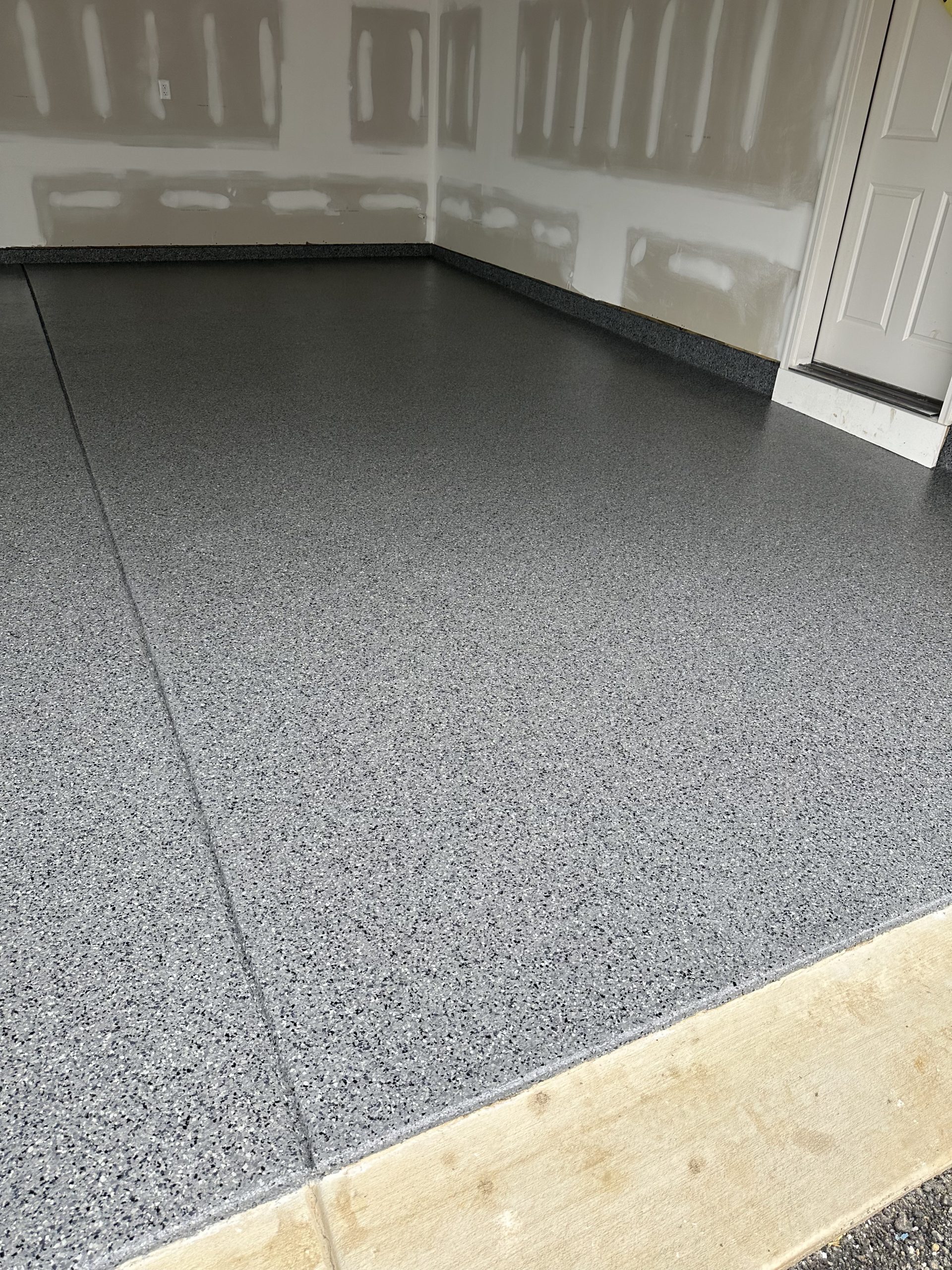
From that point on a refinish is a normal job. Base coat, flake broadcast by hand until the surface will not take more, scrape back, vacuum, polyaspartic topcoat. Nothing about the build is different because there used to be a kit on it.
Two days on site, then a wait for the cars
Most residential garages are two days, with the stripping folded into the first. Everything on the floor comes out on the first morning: bikes, bins, the mower, whatever has been stacked in the corner since the move. Foot traffic is fine that evening once the topcoat is down. Cars are a different matter, and the third day is the one people forget to plan for, because a warm tire on a coating that is still hardening is how the whole story started.
When it is finished, the floor is a residential interior, which means it carries Cobra’s true lifetime warranty in writing. That is a long way from a can of kit and a weekend.
Before the walkthrough
Keep a few of the peeled pieces rather than sweeping them up.
Remember whether the coating was there when you bought the house or went on later.
Work out where both cars can live for about three days.
What owners of peeling floors ask us
Can you just coat over the bad parts?
No, and anyone who offers to is setting you up for the same call in a year. A new coat over a failing one has nothing better to hold onto than the film that is already letting go. The whole floor gets ground back to clean concrete, the good looking parts included, so the new system bonds to the slab itself and not to somebody else’s shortcut.
Did I cause this by parking on it too soon?
Possibly a little, but mostly no. Parking early can leave tire marks in a coating that has not hardened, and that is worth avoiding on the new floor. A film that peels in strips months or years later failed because it was laid over etched concrete instead of ground concrete. That happened before your car ever touched it.
How do I know it will not happen again?
Because the cause gets removed instead of covered. The slab is ground until it is open and clean, repaired, then built up in a full system with a polyaspartic topcoat that stands up to hot tires and salt. Ask Jimmy at the walkthrough which products go down and he will name them, and you can look them up yourself.
A peeling kit in a newer Blandon garage is frustrating, but it is usually sitting on good concrete. Take the film off properly and that slab is ready for a floor that stays put. Traction near the door is covered on the Blandon anti slip page, and everything else we do nearby is on the Blandon service area page.
Let Jimmy see what is peeling and why
A couple of photos of the tire tracks and the garage size are plenty to start. Jimmy calls back inside a business day and usually gets out for a look at the slab within the week.
Call (484) 942-3219 or tell us about the floor. OSHA certified crew, PA HIC 177204.
Book a walkthrough