
Specifying a city stockroom floor for pallet jacks
A stockroom floor that sees a loaded pallet jack every hour is a different animal from a garage. The spec starts with what rolls across it, where it turns and when the doors have to be open.
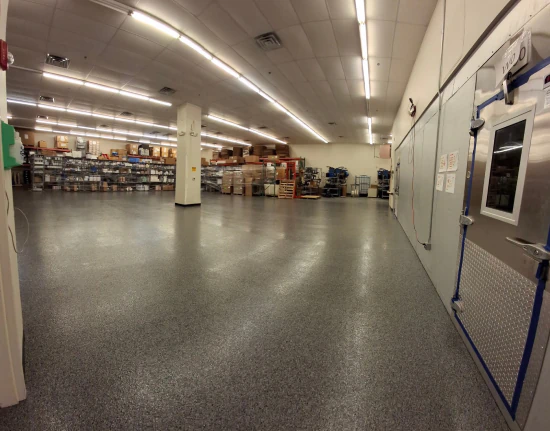
Reading is the county seat, and a lot of its working floors belong to shops, stores and the stockrooms behind them. When an owner calls about one, the conversation that follows is nothing like a basement or a garage. A store floor takes deliveries, carts, staff on their feet all day and a pallet jack shuttling stock from the back door to the shelves. We specify those floors for pallet jacks and constant traffic from the first measurement, rather than taking a residential system and assuming more of it will do.
Specified for the load, never scaled up from a house
A garage coating is designed around a car parked in the same spot and a person walking past it. A stockroom asks for something else: small hard wheels, a heavy load concentrated on them, and the same route traveled dozens of times every day.
Pushing more of a house system at that problem does not answer it. The questions a commercial spec has to answer are different ones. What is the heaviest thing that rolls across this floor? Where does it turn, since a turning wheel scrubs the surface in a way a straight run does not? Where does stock land when it comes off a delivery, and what gets dropped there?
Those answers decide the system and the build of the coating, and they come from walking the floor with whoever runs it. The staff who push the jack every morning usually know where the floor takes a beating better than anyone else in the building. Our Reading commercial floor page lays out the full range of commercial work.
Find the spot where the pallet jack turns. That is where a store floor wins or loses.
Reading the route before the slab
On a commercial walkthrough we trace the traffic before we look closely at the concrete. Back door to stockroom, stockroom to sales floor, the corner where a loaded jack swings around the end of an aisle, the strip in front of the coolers where carts stop and start.
Then the slab, which in older city buildings can hold surprises. There may be a previous coating, tile adhesive, sealer or plain bare concrete, and each one changes the prep. The route tells us which areas need the most attention and the slab tells us how much work sits underneath it.
Every floor, commercial or not, is mechanically ground to clean, open concrete with diamond grinders. That gives the coating something real to bond into, where an etched or pressure washed surface gives it very little. Cracks and divots get repaired at this stage as well. On a store floor the repairs along the traffic route get the closest look, because a small chip in a turning area is where a failure would begin.
Keeping the doors open while the floor goes in
Most owners assume a new floor means closing for a stretch. Usually it does not. One of our commercial customers put it simply in a review: they worked around the busy business schedule so the store never had to close.
That takes planning. We need your real business hours, including the quiet times you can actually give up and the ones you cannot. The floor is split into sections that match how the space already divides, so part of the store is always open and there is always a clear path through it. Stockrooms are often easier to take first, because they can be emptied onto the sales floor for a short time.
The schedule gets agreed and put in writing before any grinder is switched on. When a section can take foot traffic and when it can take wheels again are two separate times, and both go in that schedule as stated hours. Temperature affects cure, so a cold stockroom might need heat or a longer window, and we would rather say that at the start than find it out halfway through the job.
Dust, noise and a van parked on the street
City commercial work comes with access limits a suburban plaza does not have. Plenty of Reading storefronts have no loading dock and no lot, so the van parks on the street and grinders, extraction and material come in through whichever door works best. Access like that gets built into the way we quote, so it is never an afterthought.
Inside, dust is the thing an open business cares about most. Every grinder runs with dust extraction attached for as long as it runs, and our equipment is OSHA certified, which matters on an occupied site and tends to matter to landlords too. Grinding is still loud, so the noisiest sections get scheduled around your quiet times wherever possible, and sections next to an office or a register get planned around.
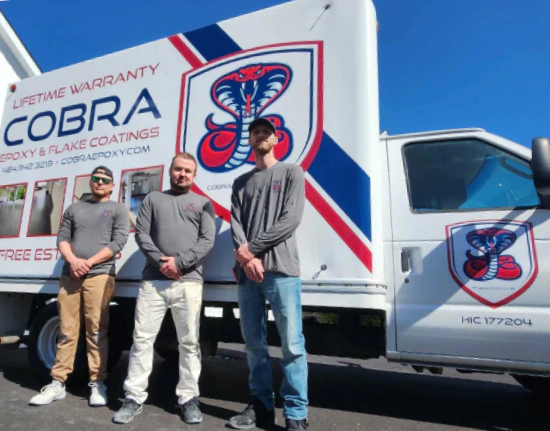
We carry PA HIC 177204.
Joints, cracks and the upkeep that keeps it working
A large floor moves slightly with temperature, and its control joints exist to let it. Coating straight across a joint means the joint shows through in a season, so joints get treated as joints and respected in the finished surface. Actual cracks are a different thing, and they get opened and repaired before coating, since one left under the finish reappears in the same shape. Our page on crack repair for Reading explains how we tell the two apart.
Once the floor is in, looking after it is mostly routine. Sweep or dust mop the aisles, and wash with warm water and a neutral cleaner. Keep acidic cleaners, wax and polish off it, because they either damage the finish or build up a dull film that makes a clean floor look tired.
A store floor is working equipment. Treat it that way from the spec onward and it keeps working.
What helps us spec a store floor
Your business hours, and the quiet windows you can actually give up.
The heaviest thing that rolls across the floor.
Where deliveries come in and where the stock goes next.
Questions store owners ask us
Can you do the stockroom now and the sales floor later?
Yes, and it is often the sensible order. A stockroom can usually be cleared for a short window more easily than a sales floor can. We schedule both parts from the same plan so the materials and the finish match, then keep a clear, walkable route between the finished section and the one still waiting its turn.
How soon can the pallet jack go back on a new section?
That depends on the system and on the temperature in the room, and we give it as a stated hour in the written schedule rather than a rough guess. Foot traffic comes back first. Wheels wait longer, because a loaded jack turning on a floor that has not fully hardened leaves marks you would see for years.
Does the entrance need anything different?
It takes the worst of it. In winter every customer carries road salt and grit in on their shoes, and the first few feet inside the door see more of that than anywhere else in the store. That strip gets the same grinding and repair as the rest of the floor, and it is usually the first place we look for damage on the walkthrough.
Every store is a little different, and the only reliable spec comes from walking the actual route with the actual equipment in view. Other work we do around the city is listed on the Reading service area page.
Tell us what rolls across your floor
Send the rough square footage, how the space is used and the hours you’re open. Jimmy calls back within a business day to walk the route with you.
Call (484) 942-3219 or fill in the contact form. OSHA certified equipment, PA HIC 177204.
Book a walkthrough